174. Intercepts of Linear Graphs
Learning Intentions
- Know that the
-intercept is the point on the Draw where the -coordinate is zero - Understand that the
-intercept is the point on the graph where the -coordinate is zero - Solve the
-intercept of a rule by solving an equation - Find the
-intercept of a rule by substituting - Draw linear graphs by first finding the axes intercepts
Pre-requisite Summary
- A point on a graph is written as an ordered pair
- A point lies on a graph if its coordinates satisfy the rule
- The
-axis is the horizontal axis, where - The
-axis is the vertical axis, where - Substitution can be used to test whether a point lies on a graph
- Solving a linear equation can be used to find an unknown value
- A linear graph is a straight line
- Two points are enough to sketch a straight line
Worked Examples
Worked Example 1
Find the
Worked Example 2
Find the
Worked Example 3
Find both intercepts of the rule
Worked Example 4
Find both intercepts of the rule
Worked Example 5
Sketch the graph of
Worked Example 6
Sketch the graph of
Problems
Problem 1
Find the
Problem 2
Find the
Problem 3
Find both intercepts of the rule
Problem 4
Find both intercepts of the rule
Problem 5
Sketch the graph of
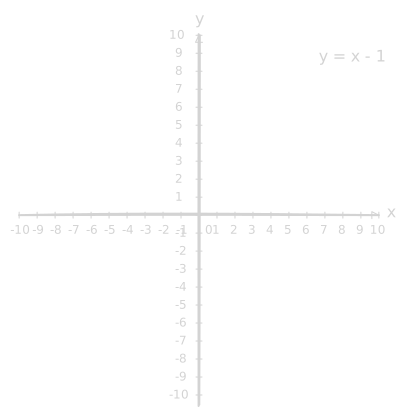
Problem 6
Sketch the graph of
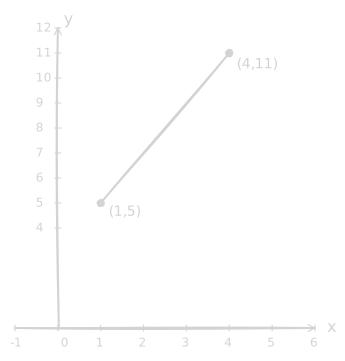
Exercises
Understanding and Fluency
Exercise 1.
State the coordinate of each type of intercept in general form.
a) the
b) the
Exercise 2.
For each rule, find the
a)
b)
c)
Exercise 3.
For each rule, find the
a)
b)
c)
Exercise 4.
Find both intercepts of each rule.
a)
b)
c)
Exercise 5.
Find both intercepts of each rule.
a)
b)
c)
Exercise 6.
Find both intercepts of each rule.
a)
b)
c)
Exercise 7.
Sketch the graph of each rule by first finding the intercepts.
a)
b)
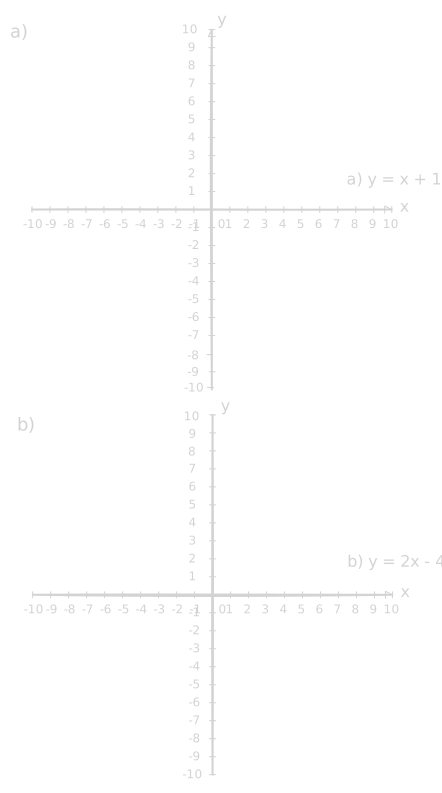
Exercise 8.
Sketch the graph of each rule by first finding the intercepts.
a)
b)
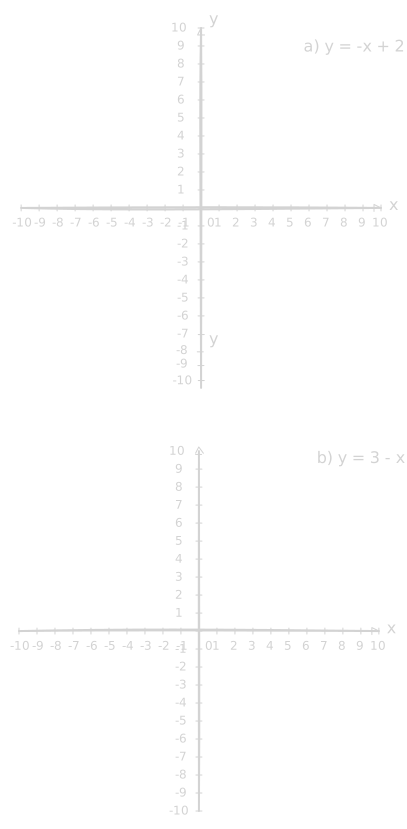
Exercise 9.
Match each rule to its intercepts.
a)
b)
c)
Intercepts:
i)
ii)
iii)
Exercise 10.
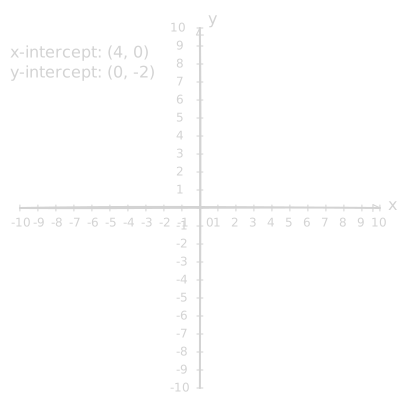
A rule has
Sketch the line.
Reasoning
Exercise 11.
Explain why the
Exercise 12.
Explain why substituting
Exercise 13.
A student says the
Exercise 14.
A student says the point
Exercise 15.
Explain why two intercepts are enough to sketch a straight-line graph when both exist.
Problem-solving
Exercise 16.
A taxi fare is modelled by
Find the
Exercise 17.
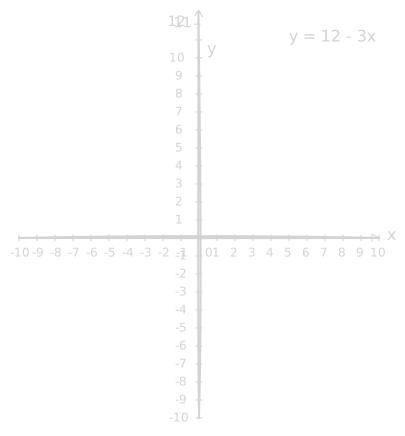
A line is given by the rule
Find the intercepts and sketch the graph.
Exercise 18.
A pattern rule is
Find the intercepts and explain whether the
Exercise 19.
A student wants to sketch the graph of
Find the
Exercise 16.
A builder compares a rule for material length,
Find both intercepts and Use them to sketch the graph.
Potential Misunderstandings
- Thinking the
-intercept is where instead of where - Thinking the
-intercept is where instead of where - Forgetting that an intercept is a point, not just a single number
- Substituting
when trying to find the -intercept - Substituting
when trying to find the -intercept - Solving the equation incorrectly when finding the
-intercept - Reversing the coordinates of an intercept, for example writing
instead of - Thinking every line must have two different intercepts in the first quadrant
- Plotting the intercepts correctly but not drawing a straight line through them
- Forgetting that the intercept method works because points on the axes have one coordinate equal to zero