106e. Polygons and Angle Sums
Learning Intentions
- To understand that polygons can be convex or non-convex
- To know the names of different types of polygons with up to 12 sides
- To understand what a regular polygon is
- Solve the angle sum of a polygon, and to Use this to find unknown angles
Pre-requisite Summary
- Know that a polygon is a closed two-dimensional shape made from straight sides
- Know that a polygon has sides, vertices and interior angles
- Understand that an interior angle is an angle inside a shape
- Recall that a convex shape has all interior angles less than
- Recall that a non-convex shape has at least one interior angle greater than
- Be able to count the number of sides of a shape accurately
- Know that angles in a triangle add to
- Know that angles in a quadrilateral add to
Worked Examples
Worked Example 1
State whether each polygon is convex or non-convex:
a) a polygon with all interior angles less than
b) a polygon with one interior angle of
Worked Example 2
Name each polygon:
a) a polygon with
b) a polygon with
c) a polygon with
Worked Example 3
State whether each polygon is regular or not regular:
a) a polygon with all sides equal and all angles equal
b) a polygon with all sides equal but angles not all equal
c) a polygon with all angles equal but sides not all equal
Worked Example 4
Find the angle sum of each polygon:
a) a pentagon
b) a hexagon
c) an octagon
Worked Example 5
Use the angle sum of a polygon to find the unknown angle:
a) a pentagon has interior angles
b) a hexagon has five interior angles of
Worked Example 6
A regular polygon has:
a)
b)
Problems
Problem 1
State whether each polygon is convex or non-convex:
a) a polygon with all interior angles less than
b) a polygon with one interior angle of
Problem 2
Name each polygon:
a) a polygon with
b) a polygon with
c) a polygon with
Problem 3
State whether each polygon is regular or not regular:
a) a polygon with all sides equal and all angles equal
b) a polygon with unequal sides
c) a polygon with equal sides but one different angle
Problem 4
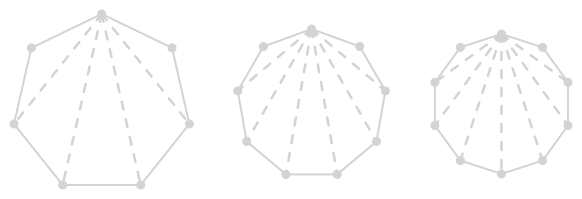
Find the angle sum of each polygon:
a) a heptagon
b) a nonagon
c) a decagon
Problem 5
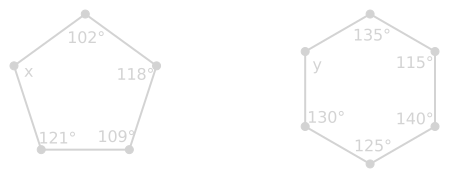
Use the angle sum of a polygon to find the unknown angle:
a) a pentagon has interior angles
b) a hexagon has five interior angles of
Problem 6
A regular polygon has:
a)
b)

Exercises
Understanding and Fluency
Exercise 1.
State whether each polygon is convex or non-convex:
a) all interior angles are less than
b) one interior angle is
c) one interior angle is reflex
Exercise 2.
Name each polygon:
a)
b)
c)
d)
e)
Exercise 3.
Name each polygon:
a)
b)
c)
d)
e)
Exercise 4.
Complete the table:
a) polygon with
b) polygon with
c) polygon with
d) polygon with
Exercise 5.
State whether each polygon is regular or not regular:
a) all sides and all angles are equal
b) all sides are equal but one angle is different
c) all angles are equal but side lengths are different
Exercise 6.
Find the angle sum of each polygon:
a) pentagon
b) hexagon
c) heptagon
d) octagon

Exercise 7.
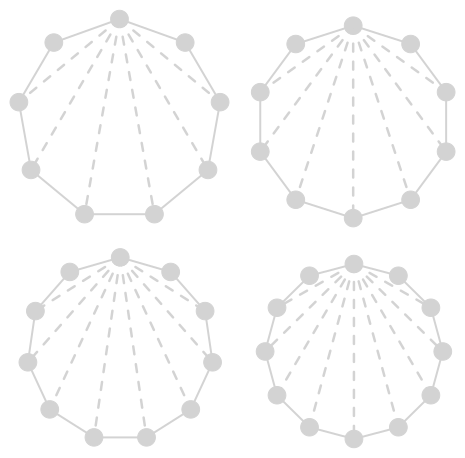
Find the angle sum of each polygon:
a) nonagon
b) decagon
c) hendecagon
d) dodecagon
Exercise 8.
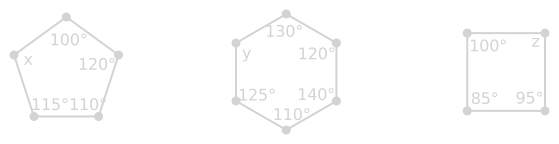
Use the angle sum to find each unknown angle:
a) a pentagon has angles
b) a hexagon has angles
c) a quadrilateral has angles
Reasoning
Exercise 9.
Explain why a regular polygon must be convex.
Exercise 10.
A student says that any polygon with equal sides is regular. Explain the mistake.
Exercise 11.
Noah says that a polygon with
Exercise 12.
Explain why the angle sum of a hexagon is greater than the angle sum of a pentagon.
Exercise 13.
A student says that a non-convex polygon cannot be a polygon because it “bends inward”. Describe the error.
Problem-solving
Exercise 14.
A polygon has

Exercise 15.
A regular pentagon has equal interior angles. Find the size of each interior angle.

Exercise 16.
A hexagon has interior angles
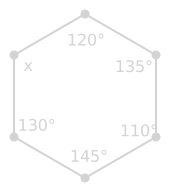
Exercise 17.
A regular decagon is used in a tiling design. Find the sum of its interior angles and the size of each interior angle.

Exercise 18.
A polygon has one interior angle greater than
Exercise 19.
A mystery polygon has interior angle sum
Potential Misunderstandings
- Students may think convex means symmetrical rather than describing the size of the interior angles
- Students may think a non-convex polygon is not a valid polygon
- Students may confuse the names of polygons with similar prefixes, such as nonagon and decagon
- Students may think a regular polygon only needs equal sides, rather than equal sides and equal angles
- Students may think all polygons with equal angles are regular even if the sides are unequal
- Students may forget that the angle sum depends on the number of sides
- Students may mix up the angle sum of a polygon with the size of each interior angle in a regular polygon
- Students may make arithmetic errors when subtracting known angles from the angle sum
- Students may confuse interior angles with exterior angles
- Students may rely on the appearance of a diagram instead of the stated properties