105. Quadrilaterals and Their Angle Properties
Learning Intentions
- To know the meaning of the terms convex and non-convex
- Identify quadrilaterals as parallelograms, rectangles, rhombuses, squares, kites and/or trapeziums
- Use the angle sum of a quadrilateral to Solve unknown angles
- To understand that properties of angles in parallel lines can be used to find unknown angles in trapeziums and parallelograms
Pre-requisite Summary
- Know that a quadrilateral is a polygon with
sides - Recall that interior angles are the angles inside a shape
- Know that the interior angles of parallel lines can form corresponding, alternate and co-interior angle pairs
- Know that co-interior angles on parallel lines add to
- Be able to Identify equal sides, right angles and parallel sides from a diagram
- Recall that the angle sum of a quadrilateral is
- Know that a convex shape has all interior angles less than
- Know that a non-convex shape has at least one interior angle greater than
Worked Examples
Worked Example 1
State whether each quadrilateral is convex or non-convex:
a) a quadrilateral with all interior angles less than
b) a quadrilateral with one interior angle of
Worked Example 2
Classify each quadrilateral:
a) a quadrilateral with two pairs of parallel sides
b) a quadrilateral with four right angles and opposite sides equal
c) a quadrilateral with four equal sides and four right angles
Worked Example 3
Classify each quadrilateral:
a) a quadrilateral with four equal sides but not all angles right angles
b) a quadrilateral with two pairs of adjacent equal sides
c) a quadrilateral with one pair of parallel sides
Worked Example 4
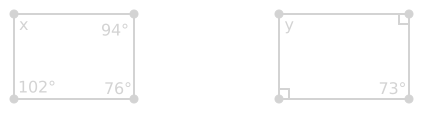
Use the angle sum of a quadrilateral to find the unknown angle:
a) angles are
b) angles are
Worked Example 5
A parallelogram has one interior angle of
a) an adjacent interior angle
b) the opposite interior angle
Worked Example 6
A trapezium has parallel sides. Two interior angles on the same side of a transversal are
Problems
Problem 1
State whether each quadrilateral is convex or non-convex:
a) a quadrilateral with interior angles
b) a quadrilateral with one interior angle of
Problem 2
Classify each quadrilateral:
a) a quadrilateral with two pairs of parallel sides
b) a quadrilateral with four right angles and all sides equal
c) a quadrilateral with four right angles
Problem 3
Classify each quadrilateral:
a) a quadrilateral with four equal sides
b) a quadrilateral with two pairs of adjacent equal sides
c) a quadrilateral with exactly one pair of parallel sides
Problem 4
Use the angle sum of a quadrilateral to find the unknown angle:
a) angles are
b) angles are
Problem 5
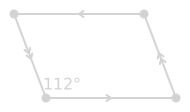
A parallelogram has one interior angle of
a) an adjacent interior angle
b) the opposite interior angle
Problem 6
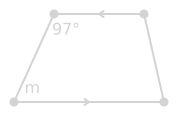
A trapezium has parallel sides. Two interior angles on the same side of a transversal are
Exercises
Understanding and Fluency
Exercise 1.
State whether each quadrilateral is convex or non-convex:
a) all interior angles are less than
b) one interior angle is
c) one interior angle is reflex
Exercise 2.
Classify each quadrilateral:
a) two pairs of parallel sides
b) four right angles
c) four equal sides
d) two pairs of adjacent equal sides
Exercise 3.
Name the most specific quadrilateral:
a) four equal sides and four right angles
b) one pair of parallel sides
c) opposite sides parallel and equal
d) four equal sides, no right angle stated
Exercise 4.
Use the angle sum of a quadrilateral to find each unknown angle:
a)
b)
c)

Exercise 5.
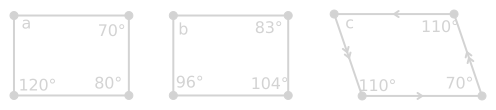
Find the missing angle in each quadrilateral:
a)
b)
c)
Exercise 6.
In a parallelogram, one angle is
a) the opposite angle
b) an adjacent angle
c) the other adjacent angle
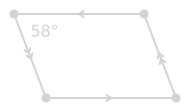
Exercise 7.
In a parallelogram, one angle is
a) the opposite angle
b) an adjacent angle
c) all four angles
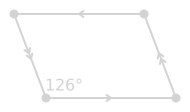
Exercise 8.
In a trapezium, consecutive interior angles between the parallel sides are co-interior. Find each unknown:
a)
b)
c)

Reasoning
Exercise 9.
Explain why a square can also be called a rectangle and a rhombus.
Exercise 10.
A student says that every trapezium is a parallelogram because both shapes have parallel sides. Explain the mistake.
Exercise 11.
Noah says that a rhombus must have four right angles. Is he correct? Explain.
Exercise 12.
Explain why adjacent angles in a parallelogram are supplementary.
Exercise 13.
A student says a quadrilateral with one interior angle greater than
Problem-solving
Exercise 14.
A quadrilateral has interior angles
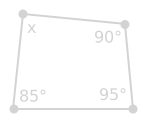
Exercise 15.
A window frame is shaped like a rectangle. Three interior angles are right angles. Find the fourth angle.

Exercise 16.
In a parallelogram, one interior angle is
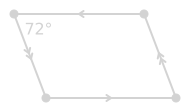
Exercise 17.
A trapezium has one pair of parallel sides. One angle on a transversal is
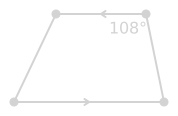
Exercise 18.
A quadrilateral has side properties showing two pairs of adjacent equal sides. Classify the quadrilateral and state whether this information guarantees any parallel sides.
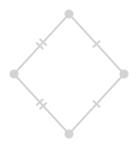
Exercise 19.
A shape has four equal sides and one interior angle of
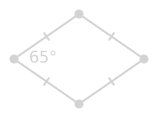
Potential Misunderstandings
- Students may think convex means symmetrical, rather than having all interior angles less than
- Students may think any quadrilateral with parallel sides is a parallelogram
- Students may confuse a kite with a rhombus
- Students may think a rectangle must have all sides equal
- Students may think a rhombus must have four right angles
- Students may not realise that a square belongs to more than one quadrilateral family
- Students may forget that the interior angles of a quadrilateral add to
- Students may confuse opposite angles with adjacent angles in a parallelogram
- Students may forget that adjacent angles in a parallelogram add to
- Students may not Recognise co-interior angles inside trapeziums when parallel sides are present
- Students may rely on the appearance of a diagram instead of the stated properties
- Students may think non-convex quadrilaterals are impossible because they “bend inward”