104r. Reviewing Classifying Triangles and Finding Angles
Learning Intentions
- To understand that triangles can be classified by their side lengths as scalene, isosceles or equilateral
- To understand that triangles can be classified by their interior angles as acute, right or obtuse
- Use the angle sum of a triangle to Solve unknown angles
- use the exterior angle theorem to find unknown angles
Pre-requisite Summary
- Know that a triangle has
sides, vertices and interior angles - Understand that side lengths can be compared to decide whether sides are equal or different
- Recall that angles are measured in degrees, written as
- Know how to Identify angles as acute, right or obtuse
- Understand that a right angle is
- Be able to Identify interior and exterior angles on a diagram
- Know that angles on a straight line add to
- Be familiar with finding unknown angles Use angle facts
Worked Examples
Worked Example 1
Classify each triangle by its side lengths:
a) sides
b) sides
c) sides
Worked Example 2
Classify each triangle by its interior angles:
a) angles
b) angles
c) angles
Worked Example 3
Use the angle sum of a triangle to find the unknown angle:
a) angles are
b) angles are
c) angles are
Worked Example 4
An isosceles triangle has two equal angles of
Worked Example 5
Use the exterior angle theorem to find the exterior angle:
a) remote interior angles are
b) remote interior angles are
Worked Example 6
Use the exterior angle theorem to find the unknown interior angle:
a) an exterior angle is
b) an exterior angle is
Problems
Problem 1
Classify each triangle by its side lengths:
a) sides
b) sides
c) sides
Problem 2
Classify each triangle by its interior angles:
a) angles
b) angles
c) angles
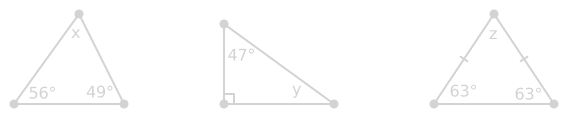
Problem 3
Use the angle sum of a triangle to find the unknown angle:
a) angles are
b) angles are
c) angles are
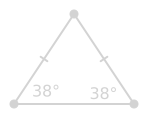
Problem 4
An isosceles triangle has two equal angles of
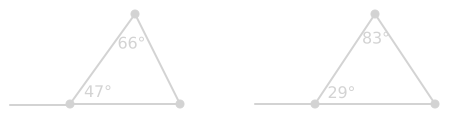
Problem 5
Use the exterior angle theorem to find the exterior angle:
a) remote interior angles are
b) remote interior angles are
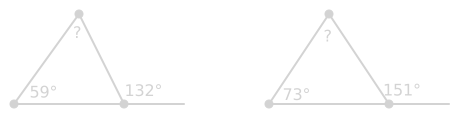
Problem 6
Use the exterior angle theorem to find the unknown interior angle:
a) an exterior angle is
b) an exterior angle is
Exercises
Understanding and Fluency
Exercise 1.
Classify each triangle by its side lengths:
a) sides
b) sides
c) sides
Exercise 2.
Classify each triangle by its interior angles:
a)
b)
c)
Exercise 3.
State whether each triangle is scalene, isosceles or equilateral:
a) all sides different
b) two sides equal
c) all sides equal
Exercise 4.
State whether each triangle is acute, right or obtuse:
a) all angles less than
b) one angle equal to
c) one angle greater than
Exercise 5.
Use the angle sum of a triangle to find each unknown angle:
a)
b)
c)
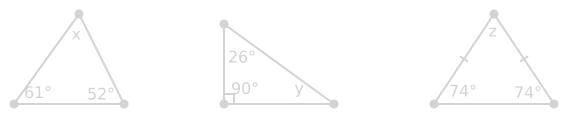
Exercise 6.
Find the missing angle in each triangle:
a)
b)
c)
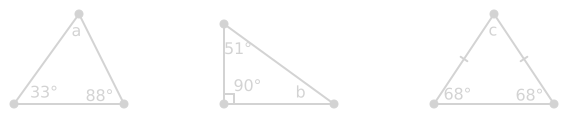
Exercise 7.
Use the exterior angle theorem to find each exterior angle:
a) remote interior angles
b) remote interior angles
c) remote interior angles

Exercise 8.
Use the exterior angle theorem to find each unknown interior angle:
a) exterior angle
b) exterior angle
c) exterior angle

Reasoning
Exercise 9.
Explain why an equilateral triangle must also be isosceles.
Exercise 10.
A student says that a triangle with angles
Exercise 11.
Noah says a triangle can be both right and obtuse. Is he correct? Explain.
Exercise 12.
Explain why the interior angles of a triangle cannot include two obtuse angles.
Exercise 13.
A student says the exterior angle of a triangle is found by adding all three interior angles. Describe the error.
Problem-solving
Exercise 14.
A triangle has two equal sides and one angle of
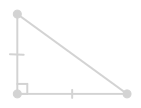
Exercise 15.
A triangular sign has interior angles of
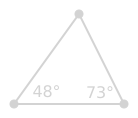
Exercise 16.
An exterior angle of a triangle is
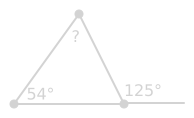
Exercise 17.
A triangle has side lengths
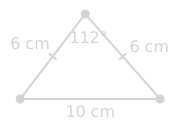
Exercise 18.
The exterior angle at one vertex of a triangle is
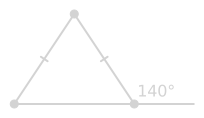
Exercise 19.
A triangle is isosceles and one of its equal angles is
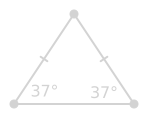
Potential Misunderstandings
- Students may think an isosceles triangle must have exactly two equal sides, rather than at least two equal sides
- Students may think an equilateral triangle is not also isosceles
- Students may confuse classification by side lengths with classification by angles
- Students may think a triangle can be both right and obtuse
- Students may forget that the interior angles of a triangle add to
- Students may make arithmetic errors when subtracting from
- Students may forget that equal sides in an isosceles triangle have equal opposite angles
- Students may confuse an exterior angle with an interior angle
- Students may think the exterior angle theorem uses the two adjacent interior angles instead of the two remote interior angles
- Students may forget that an exterior angle is equal to the sum of the two remote interior angles
- Students may rely only on the appearance of a diagram instead of using the given angle facts