107e. Naming Solids and Using Euler’s Rule
Learning Intentions
- To know the meaning of the terms polyhedron, prism, pyramid, cylinder, sphere, cone, cube and cuboid
- name solids Use appropriate terminology (e.g. hexagonal prism, square pyramid)
- Use Euler’s rule to relate the number of faces, vertices and edges in a polyhedron
Pre-requisite Summary
- Know that a three-dimensional object is a solid with length, width and height
- Be able to distinguish between flat faces, curved surfaces, edges and vertices
- Know that polygons can be used to Describe the cross-sections or bases of some solids
- Understand that names such as triangular, square and hexagonal describe the shape of a base
- Be able to count faces, edges and vertices carefully from a diagram or model
- Know that not all solids are polyhedra, because some have curved surfaces
- Understand that a prism has matching parallel bases and a pyramid has one base with triangular faces meeting at a point
Worked Examples
Worked Example 1
State the meaning of each term:
a) polyhedron
b) prism
c) pyramid
Worked Example 2
State the meaning of each term:
a) cylinder
b) sphere
c) cone
d) cuboid
Worked Example 3
Name each solid using appropriate terminology:
a) a prism with triangular bases
b) a pyramid with a square base
c) a prism with hexagonal bases
Worked Example 4
Name each solid using appropriate terminology:
a) a solid with
b) a box-shaped solid with rectangular faces
c) a solid with one circular base and one curved surface meeting at a point
Worked Example 5
Use Euler’s rule to Solve the missing value:
a) a polyhedron has
b) a polyhedron has
Worked Example 6
Use Euler’s rule to Check whether the values could describe a polyhedron:
a)
b)
Problems
Problem 1
State the meaning of each term:
a) polyhedron
b) prism
c) pyramid
Problem 2
State the meaning of each term:
a) cylinder
b) sphere
c) cone
d) cube
Problem 3
Name each solid using appropriate terminology:
a) a prism with pentagonal bases
b) a pyramid with a triangular base
c) a prism with rectangular bases
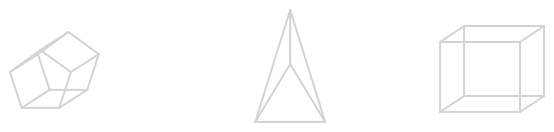
Problem 4
Name each solid using appropriate terminology:
a) a solid with
b) a solid with two circular bases and one curved surface
c) a solid with one circular base and one vertex
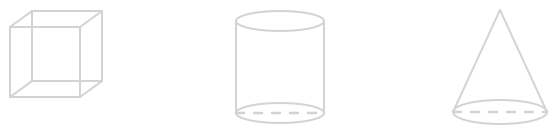
Problem 5
Use Euler’s rule to find the missing value:
a) a polyhedron has
b) a polyhedron has
Problem 6
Use Euler’s rule to check whether the values could describe a polyhedron:
a)
b)
Exercises
Understanding and Fluency
Exercise 1.
State the meaning of each term:
a) polyhedron
b) prism
c) pyramid
d) sphere
Exercise 2.
State the meaning of each term:
a) cylinder
b) cone
c) cube
d) cuboid
Exercise 3.
Name each solid:
a) a prism with triangular bases
b) a prism with octagonal bases
c) a pyramid with a square base
d) a pyramid with a pentagonal base

Exercise 4.
Name each solid:
a) a solid with
b) a solid with rectangular faces like a box
c) a solid with two circular bases
d) a solid with one circular base and one vertex
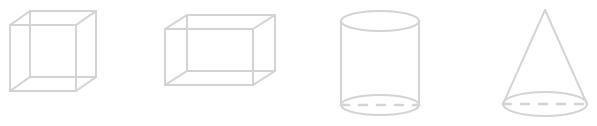
Exercise 5.
Decide whether each solid is a polyhedron:
a) cube
b) cylinder
c) triangular prism
d) sphere

Exercise 6.
Count the faces, vertices and edges of each polyhedron:
a) cube
b) triangular prism
c) square pyramid

Exercise 7.
Use Euler’s rule,
a)
b)
c)
Exercise 8.
Use Euler’s rule to check whether each set of values can describe a polyhedron:
a)
b)
c)
Reasoning
Exercise 9.
Explain why a cylinder is not a polyhedron.
Exercise 10.
A student says that a cube and a cuboid are completely different because one has squares and the other has rectangles. Explain why this is not the best way to think about the relationship.
Exercise 11.
Noah says that a triangular prism is named after its side faces. Is he correct? Explain.
Exercise 12.
Explain why Euler’s rule only applies to polyhedra and not to solids such as spheres and cones.
Exercise 13.
A student says that a square pyramid has
Problem-solving
Exercise 14.
A solid has two matching hexagonal bases and rectangular side faces. Name the solid.

Exercise 15.
A museum model is described as having one square base and four triangular faces meeting at a point. Name the solid.
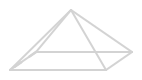
Exercise 16.
A polyhedron has
Exercise 17.
A polyhedron has
Exercise 18.
A student records a solid as having
Exercise 19.
A designer wants to label a solid as a pentagonal prism. Describe what its two bases must look like and what kind of side faces it has.
Potential Misunderstandings
- Students may think every solid is a polyhedron, even if it has curved surfaces
- Students may confuse faces with surfaces and include curved surfaces as faces in a polyhedron
- Students may confuse edges with vertices when counting parts of a solid
- Students may think a prism and a pyramid are named from any face, rather than from the shape of the base
- Students may think a cube is not a cuboid because all of its faces are squares
- Students may think a cylinder or cone can satisfy Euler’s rule in the same way as a polyhedron
- Students may forget that a prism has two matching parallel bases
- Students may forget that a pyramid has one base and triangular faces meeting at a vertex
- Students may miscount hidden edges or vertices in a diagram
- Students may use Euler’s rule incorrectly as
instead of