091e. Area of Composite Shapes
Learning Intentions
- To understand what a composite shape is
- Identify simple shapes that make up a composite shape
- Solve the area of a composite shape
Pre-requisite Summary
- Know that a composite shape is a shape made by joining two or more simple shapes
- Know that common simple shapes include rectangles, squares, triangles and parallelograms
- Know that area measures the amount of surface inside a two-dimensional shape
- Know that area is measured in square units such as
and - Know how to find the area of a rectangle Use
- Know how to find the area of a triangle using
- Know how to find the area of a parallelogram using
- Know that the total area of a composite shape can be found by adding the areas of its parts
Worked Examples
Worked Example 1
A shape is made by joining two rectangles.
One rectangle measures
Find the total area.
Worked Example 2
An L-shaped figure can be split into two rectangles.
The first rectangle measures
Find the area of the composite shape.
Worked Example 3
A composite shape is made from a rectangle and a triangle.
The rectangle measures
The triangle has base
Find the total area.
Worked Example 4
A composite shape is made from a parallelogram and a rectangle.
The parallelogram has base
The rectangle measures
Find the total area.
Worked Example 5
A shape is made from three rectangles.
Their dimensions are
Find the total area.
Worked Example 6
A garden bed is made from a rectangle and a triangle.
The rectangle is
Find the total area.
Problems
Problem 1
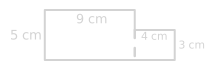
A shape is made by joining two rectangles.
One rectangle measures
Find the total area.
Problem 2
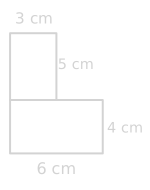
An L-shaped figure can be split into two rectangles.
The first rectangle measures
Find the area of the composite shape.
Problem 3
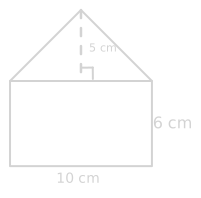
A composite shape is made from a rectangle and a triangle.
The rectangle measures
The triangle has base
Find the total area.
Problem 4
A composite shape is made from a parallelogram and a rectangle.
The parallelogram has base
The rectangle measures
Find the total area.
091e.p6.excalidraw
Excalidraw Data
Text Elements
^dummy!
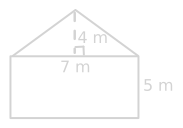
4 m
5 m
7 m
Link to original
Problem 5
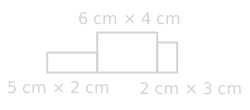
A shape is made from three rectangles.
Their dimensions are
Find the total area.
Problem 6
A garden bed is made from a rectangle and a triangle.
The rectangle is
Find the total area.
Exercises
Understanding and Fluency
Exercise 1.
Decide whether each shape is a composite shape.
a) A shape made from two joined rectangles
b) A single square
c) A shape made from a triangle and a rectangle
Exercise 2.
Identify the formula for the simple shapes that make up each composite shape.
a) An L-shape split into two rectangles
b) A house-shaped figure split into a rectangle and a triangle
c) A shape split into a parallelogram and a rectangle
Exercise 3.
Find the total area of each composite shape.
a) Two rectangles:
b) Two rectangles:
c) Two rectangles:
Exercise 4.
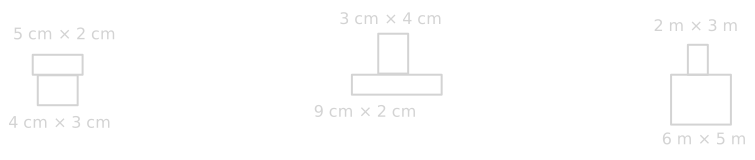
Find the total area of each composite shape.
a) Rectangle
b) Rectangle
c) Rectangle

Exercise 5.
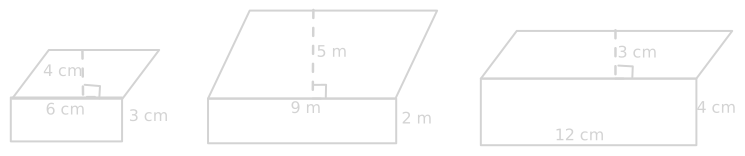
Find the total area of each composite shape.
a) Parallelogram with base
b) Parallelogram with base
c) Parallelogram with base
Exercise 6.
An L-shaped figure is split into two rectangles. Find the area.
a)
b)
c)

Exercise 7.
A shape is made from three rectangles. Find the total area.
a)
b)
c)

Exercise 8.
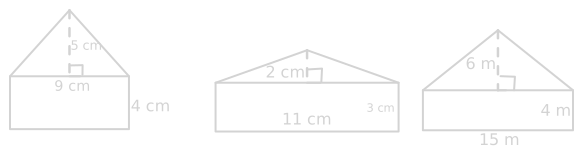
Find the total area of each composite shape.
a) Rectangle
b) Rectangle
c) Rectangle
Reasoning
Exercise 9.
Explain why splitting a composite shape into simple shapes helps to find its area.
Exercise 10.
A student says the area of a composite shape is found by adding all the side lengths. Explain why this is incorrect.
Exercise 11.
A composite shape is made from a rectangle and a triangle. Explain why the total area is found by adding the two areas, not multiplying them together.
Exercise 12.
A student splits the same composite shape in two different valid ways and gets the same total area. Explain why this happens.
Problem-solving
Exercise 13.
A patio is made from two rectangles. One is
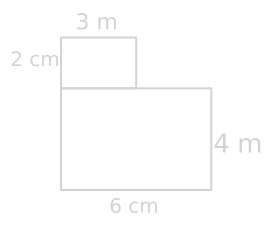
Exercise 14.
A sign is made from a rectangle
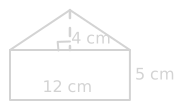
Exercise 15.
A floor plan shows an L-shaped room split into two rectangles measuring
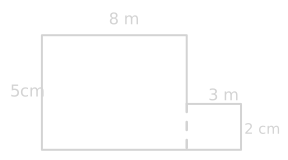
Exercise 16.
A garden bed is made from a parallelogram with base
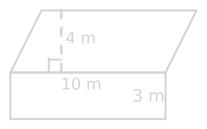
Exercise 17.
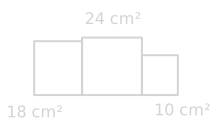
A composite tile design is made from three rectangles with areas
Exercise 18.
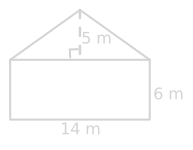
A playground section is made from a rectangle
Potential Misunderstandings
- A student may think a composite shape is a completely new type of shape rather than a shape made from simple shapes
- A student may not identify all of the simple shapes needed to split the figure correctly
- A student may confuse area with perimeter and add outside side lengths instead of areas
- A student may Use the wrong formula for one of the simple shapes
- A student may forget to divide by
when finding the area of a triangle - A student may use a slanted side instead of the perpendicular height
- A student may multiply or add measurements that belong to different parts of the shape incorrectly
- A student may find the areas of the parts correctly but then combine them incorrectly
- A student may omit square units in the final answer