092. Volume of Rectangular Prisms
Learning Intentions
- To understand what the volume of a three-dimensional object is
- To know that common metric units for volume include cubic millimetres, cubic centimetres, cubic metres and cubic kilometres
- To know what a rectangular prism (or cuboid) is
- Solve the volume of a cube and other rectangular prisms
Pre-requisite Summary
- Know that three-dimensional objects have length, width and height
- Know that volume measures the amount of space inside a three-dimensional object
- Know that volume is measured in cubic units such as
, , and - Know that a cubic unit means a
cube - Know that a rectangular prism has
rectangular faces - Know that a cube is a special rectangular prism with all edges equal
- Know how to multiply whole numbers and decimals
- Know that the volume of a rectangular prism is found Use
Worked Examples
Worked Example 1
Decide whether each statement describes volume.
a) The amount of space inside a box
b) The distance around the edge of a shape
c) The amount of space a solid object takes up
Worked Example 2
Name the most suitable metric unit for the volume of each object.
a) A lunchbox
b) A shipping container
c) A tiny grain of sand
Worked Example 3
A rectangular prism has length
Worked Example 4
A cube has side length
Worked Example 5
A rectangular prism has dimensions
Worked Example 6
A storage box is
Problems
Problem 1
Decide whether each statement describes volume.
a) The amount of space inside a solid
b) The area of a flat surface
c) The space taken up by a 3D object
Problem 2
Name the most suitable metric unit for the volume of each object.
a) A classroom
b) A small dice
c) A very large mountain of rock
Problem 3
A rectangular prism has length
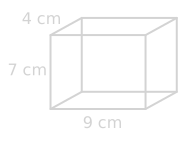
Problem 4
A cube has side length
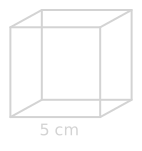
Problem 5
A rectangular prism has dimensions
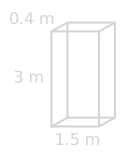
Problem 6
A fish tank is
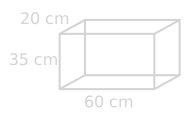
Exercises
Understanding and Fluency
Exercise 1.
Decide whether each statement is about volume.
a) The amount of space inside a solid
b) The distance around a shape
c) The number of cubic units needed to fill a solid
Exercise 2.
Choose the most suitable metric unit for volume.
a) A tiny bead
b) A shoebox
c) A large building
Exercise 3.
Complete the statements.
a) Volume is measured in
b) A rectangular prism is a
c) A cube is a special type of
Exercise 4.
Find the volume of each rectangular prism.
a)
b)
c)
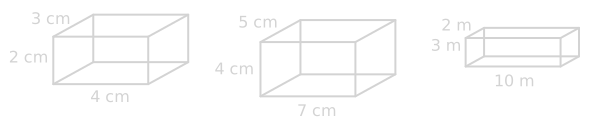
Exercise 5.
Find the volume of each cube.
a) Side length
b) Side length
c) Side length
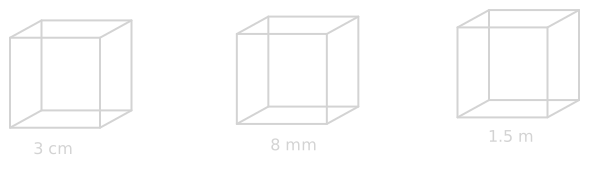
Exercise 6.
Find the volume of each rectangular prism.
a) Length
b) Length
c) Length
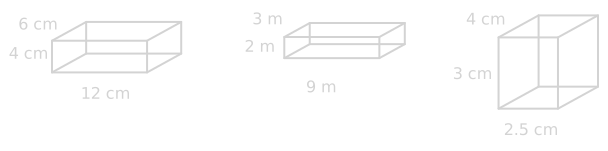
Exercise 7.
Find the missing dimension.
a)
b)
c)
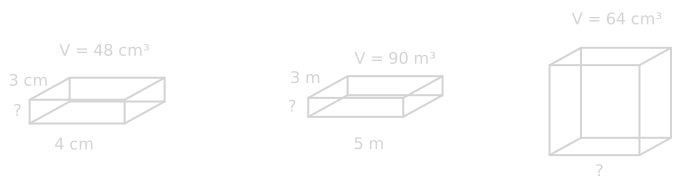
Exercise 8.
Decide whether each solid is a rectangular prism.
a) A cube
b) A cylinder
c) A box-shaped brick
Reasoning
Exercise 9.
Explain why volume is measured in cubic units rather than square units.
Exercise 10.
A student says the volume of a rectangular prism is found by adding its length, width and height. Explain why this is incorrect.
Exercise 11.
Explain why a cube can be found using the same volume rule as a rectangular prism.
Exercise 12.
A rectangular prism has dimensions
Problem-solving
Exercise 13.
A gift box is
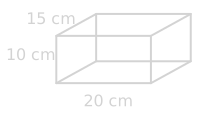
Exercise 14.
A storage crate is shaped like a cube with side length
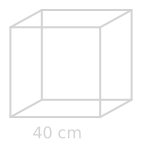
Exercise 15.
A fish tank is
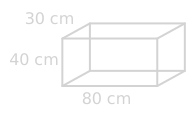
Exercise 16.
A shipping container is
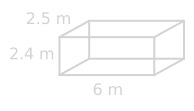
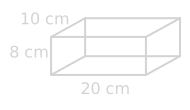
Exercise 17.
A brick has dimensions
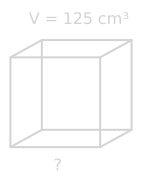
Exercise 18.
A cube-shaped container has volume
Potential Misunderstandings
- A student may confuse volume with area and think volume measures a flat surface
- A student may confuse volume with perimeter and think volume is about the distance around an object
- A student may Use square units instead of cubic units
- A student may not Recognise that a cube is a special rectangular prism
- A student may multiply only two dimensions instead of three
- A student may add the dimensions instead of multiplying them
- A student may omit the units or write incorrect units in the final answer
- A student may think cubic units are only used for cubes, rather than for all volume measurements