090. Area of Triangles
Learning Intentions
- To understand that a triangle can be considered as half of a parallelogram
- Identify the base and the (perpendicular) height of a triangle
- Solve the area of a triangle
Pre-requisite Summary
- Know that area measures the amount of surface inside a two-dimensional shape
- Know that area is measured in square units such as
and - Know that the area of a parallelogram is found Use
- Know that a triangle has three sides and three angles
- Know that any side of a triangle can be chosen as the base
- Know that the height is the perpendicular distance from the base to the opposite vertex
- Know that the slanted side is not usually the height unless it is perpendicular to the base
Worked Examples
Worked Example 1
A parallelogram has base
Worked Example 2
Identify the base and perpendicular height of each triangle.
a) A triangle with a horizontal base of
b) A triangle with a sloping side of
Worked Example 3
Find the area of a triangle with base
Worked Example 4
Find the area of a triangle with base
Worked Example 5
A triangle has base
Worked Example 6
A triangular garden bed has base
Problems
Problem 1
A parallelogram has base
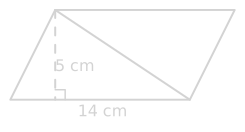
Problem 2
Identify the base and perpendicular height of each triangle.
a) A triangle with a horizontal base of
b) A triangle with a sloping side of
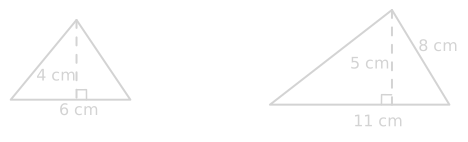
Problem 3
Find the area of a triangle with base
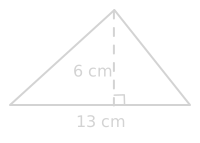
Problem 4
Find the area of a triangle with base
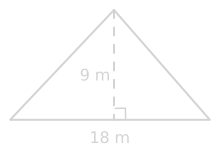
Problem 5
A triangle has base
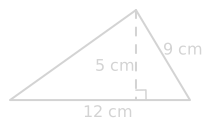
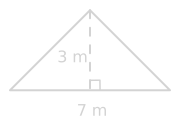
Problem 6
A triangular banner has base
Exercises
Understanding and Fluency
Exercise 1.
Decide whether each statement is true or false.
a) A triangle can be seen as half of a parallelogram with the same base and height
b) The height of a triangle must be perpendicular to the base
c) The longest side of a triangle is always the base
Exercise 2.
Complete the statements.
a) The area of a triangle is
b) The height is measured
c) Area is measured in
Exercise 3.
Identify the base and perpendicular height.
a) A triangle with base
b) A triangle with base
c) A triangle with side lengths
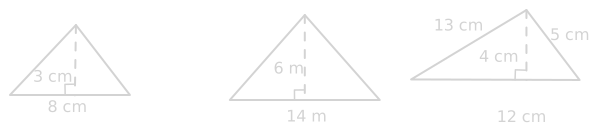
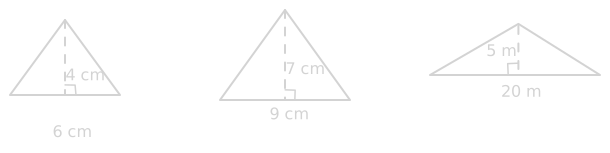
Exercise 4.
Find the area of each triangle.
a) Base
b) Base
c) Base
Exercise 5.
Find the area of each triangle.
a) Base
b) Base
c) Base
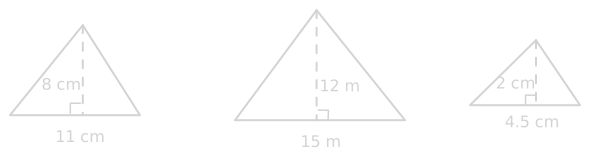
Exercise 6.
A triangle has the following measurements. Find the area.
a) Base
b) Base
c) Base
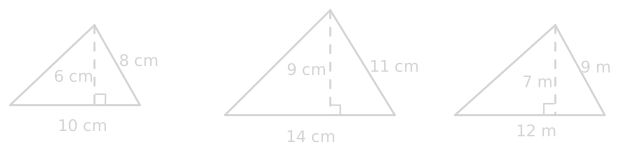
Exercise 7.
Find the missing height.
a) Area
b) Area
c) Area
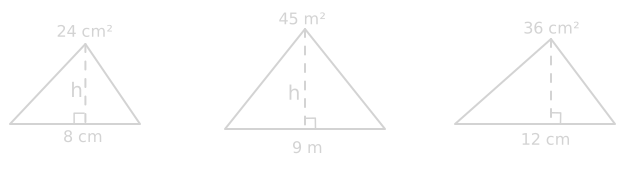
Exercise 8.
Find the missing base.
a) Area
b) Area
c) Area
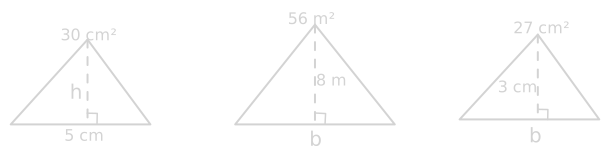
Reasoning
Exercise 9.
Explain why the area of a triangle is half the area of a parallelogram with the same base and height.
Exercise 10.
A student uses a slanted side instead of the perpendicular height when finding the area of a triangle. Explain why this is incorrect.
Exercise 11.
Explain why different triangles can have the same base and height and therefore the same area.
Exercise 12.
A triangle has base
Problem-solving
Exercise 13.
A triangular flag has base
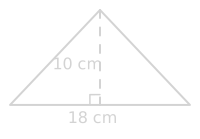
Exercise 14.
A triangular garden has base
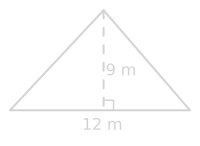
Exercise 15.
A triangle has area
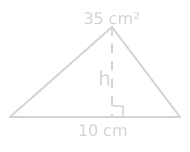
Exercise 16.
A triangle has area
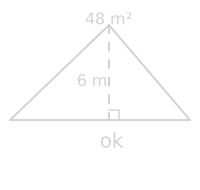
Exercise 17.
A rectangular card measures
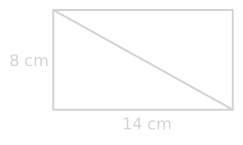
Exercise 18.
A triangle-shaped sign has base
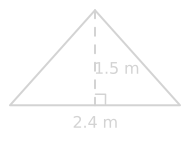
Potential Misunderstandings
- A student may think the slanted side is always the height
- A student may forget that the height must be perpendicular to the base
- A student may think the base must always be the bottom side drawn in the diagram
- A student may confuse area with perimeter
- A student may forget to divide by
after multiplying base and height - A student may multiply the wrong measurements, especially when an extra side length is given
- A student may not Recognise that two congruent triangles can be formed by splitting a parallelogram
- A student may omit square units in the final answer