063. Line and Rotational Symmetry
Learning Intentions
- To understand what a line of symmetry is
- Determine the order of line symmetry for a shape
- To understand what rotational symmetry is
- determine the order of rotational symmetry for a shape
Pre-requisite Summary
- Understand that a shape can be reflected or turned and still be compared with its original position
- Know that congruent parts match exactly in size and shape
- Be able to Identify halves of a shape that match under reflection
- Understand that a line of symmetry divides a shape into two matching mirror-image parts
- Know that a full turn is
- Understand that rotational symmetry is about turning a shape around a fixed centre
- Be able to count how many times a shape matches itself in one full turn
- Be able to distinguish between reflection symmetry and rotational symmetry
Worked Examples
Worked Example 1
a) Explain what a line of symmetry is.
b) Decide whether a given rectangle has a line of symmetry.
c) State the number of lines of symmetry.
Worked Example 2
For each shape, determine the order of line symmetry:
a) a square
b) an equilateral triangle
c) a regular pentagon
Worked Example 3
a) Explain what rotational symmetry is.
b) Describe what it means for a shape to match itself during a turn.
c) State the order of rotational symmetry of a square.
Worked Example 4
For each shape, determine the order of rotational symmetry:
a) a rectangle
b) an equilateral triangle
c) a regular hexagon
Worked Example 5
Compare the symmetries of these shapes:
a) a non-square rectangle
b) a rhombus
c) a regular octagon
For each, state the order of line symmetry and rotational symmetry.
Worked Example 6
A shape has
a) Name a possible shape.
b) Explain why it has these symmetries.
c) State the angle of rotation for one turn to the next matching position.
Problems
Problem 1
a) Explain what a line of symmetry is.
b) Decide whether a given isosceles triangle has a line of symmetry.
c) State the number of lines of symmetry.
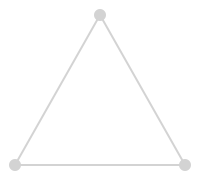
Problem 2
For each shape, determine the order of line symmetry:
a) a regular hexagon
b) a square
c) a regular octagon
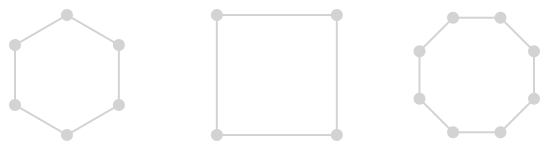
Problem 3
a) Explain what rotational symmetry is.
b) Describe what it means for a shape to match itself during a turn.
c) State the order of rotational symmetry of an equilateral triangle.
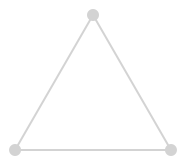
Problem 4
For each shape, determine the order of rotational symmetry:
a) a non-square rectangle
b) a regular pentagon
c) a regular octagon

Problem 5
Compare the symmetries of these shapes:
a) a kite
b) a parallelogram
c) a regular hexagon
For each, state the order of line symmetry and rotational symmetry.
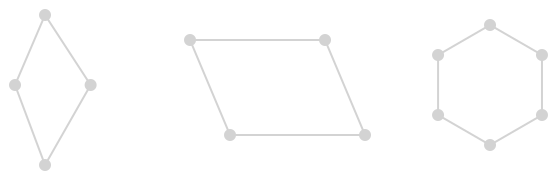
Problem 6
A shape has
a) Name a possible shape.
b) Explain why it has these symmetries.
c) State the angle of rotation for one turn to the next matching position.
Exercises
Understanding and Fluency
Exercise 1.
State whether each statement is true or false:
a) A line of symmetry divides a shape into two matching halves
b) A shape with rotational symmetry must match itself after a full turn only
c) A square has more than one line of symmetry
Exercise 2.
Determine the number of lines of symmetry for each shape:
a) a square
b) a rectangle
c) an equilateral triangle
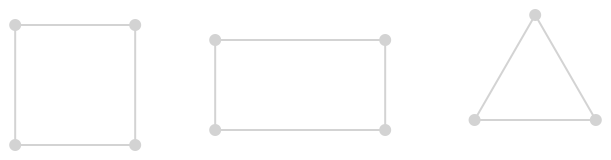
Exercise 3.
Determine the number of lines of symmetry for each shape:
a) an isosceles triangle
b) a regular pentagon
c) a regular hexagon
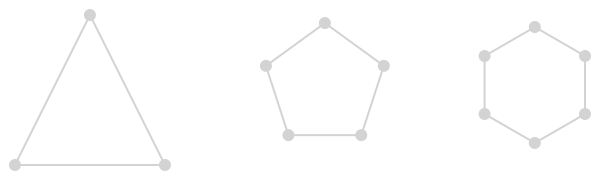
Exercise 4.
Determine the order of rotational symmetry for each shape:
a) a square
b) a rectangle
c) an equilateral triangle
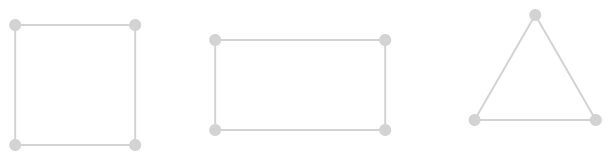
Exercise 5.
Determine the order of rotational symmetry for each shape:
a) a regular pentagon
b) a regular hexagon
c) a regular octagon

Exercise 6.
State both the line symmetry and rotational symmetry orders:
a) a non-square rectangle
b) a regular triangle
c) a regular quadrilateral

Exercise 7.
State both the line symmetry and rotational symmetry orders:
a) a parallelogram
b) a rhombus
c) a regular hexagon
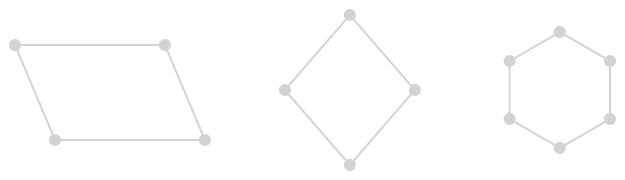
Exercise 8.
Solve the angle of rotation between matching positions:
a) rotational symmetry of order
b) rotational symmetry of order
c) rotational symmetry of order
Reasoning
Exercise 9.
Explain why a non-square rectangle has rotational symmetry of order
Exercise 10.
A student says a shape with one line of symmetry must also have rotational symmetry of order
Exercise 11.
Explain why a regular hexagon has the same order of line symmetry and rotational symmetry.
Exercise 12.
A student says a circle has rotational symmetry of order
Problem-solving
Exercise 13.
A logo matches itself after turns of
Exercise 14.
A tile has
Exercise 15.
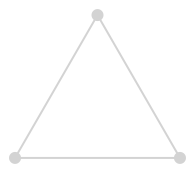
A road sign is shaped like an equilateral triangle. State its order of line symmetry and rotational symmetry.
Exercise 16.
A window frame is a non-square rectangle. State its number of lines of symmetry and order of rotational symmetry.

Exercise 17.
A design has rotational symmetry of order
Exercise 18.
A shape has no line symmetry but does have rotational symmetry of order
Potential Misunderstandings
- Students may think any line through the middle of a shape is a line of symmetry
- Students may confuse the number of lines of symmetry with the number of sides
- Students may think rotational symmetry only means a full turn of
- Students may forget that rotational symmetry is about matching before a full turn is completed
- Students may confuse the order of rotational symmetry with the angle of rotation
- Students may assume all regular polygons have only one line of symmetry
- Students may think a shape must have line symmetry if it has rotational symmetry
- Students may count matching turns incorrectly by not including the starting position when considering order