062. Interior and Exterior Angles of Triangles and Polygons
Learning Intentions
- To know that the sum of interior angles in a triangle is
- To know what an exterior angle is
- Solve exterior angles in triangles Use supplementary angles
- To understand that the angle sum of a polygon can be determined by decomposing into triangles
Pre-requisite Summary
- Understand that a triangle has
interior angles - Know that angles on a straight line add to
- Be able to Identify adjacent angles in a diagram
- Understand that an exterior angle is formed outside a shape when a side is extended
- Be able to find a missing angle in a triangle using known angle facts
- Understand that a polygon can be split into triangles by drawing diagonals from one vertex
- Know that each triangle contributes
to an interior angle sum
Worked Examples
Worked Example 1
a) Find the missing angle in a triangle with angles
b) Explain why the interior angles add to
Worked Example 2
A triangle has interior angles
a) Write an equation using the triangle angle sum.
b) Find
Worked Example 3
A side of a triangle is extended to form an exterior angle. The adjacent interior angle is
a) Explain what an exterior angle is.
b) Find the exterior angle using supplementary angles.
Worked Example 4
A triangle has an interior angle of
a) Write an equation using supplementary angles.
b) Find
Worked Example 5
A quadrilateral is decomposed into triangles by drawing one diagonal.
a) State how many triangles are formed.
b) Find the interior angle sum of the quadrilateral.
Worked Example 6
A pentagon is decomposed into triangles by drawing diagonals from one vertex.
a) State how many triangles are formed.
b) Find the interior angle sum of the pentagon.
c) Explain the rule used.
Problems
Problem 1
a) Find the missing angle in a triangle with angles
b) Explain why the interior angles add to
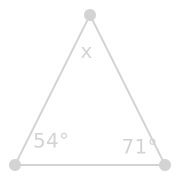
Problem 2
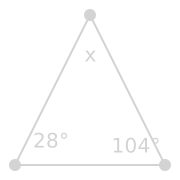
A triangle has interior angles
a) Write an equation using the triangle angle sum.
b) Find
Problem 3
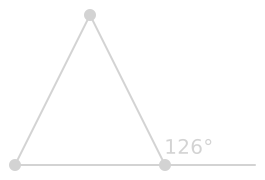
A side of a triangle is extended to form an exterior angle. The adjacent exterior angle is
a) Explain what an exterior angle is.
b) Find the interior angle using supplementary angles.
Problem 4
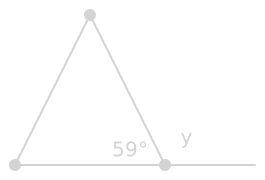
A triangle has an interior angle of
a) Write an equation using supplementary angles.
b) Find
Problem 5
A quadrilateral is decomposed into triangles by drawing one diagonal.
a) State how many triangles are formed.
b) Find the interior angle sum of the quadrilateral.

Problem 6
A hexagon is decomposed into triangles by drawing diagonals from one vertex.
a) State how many triangles are formed.
b) Find the interior angle sum of the hexagon.
c) Explain the rule used.

Exercises
Understanding and Fluency
Exercise 1.
Find the missing angle in each triangle:
a)
b)
c)
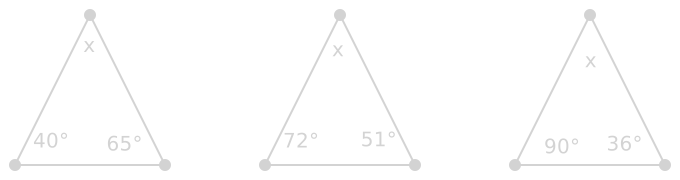
Exercise 2.
Find the missing angle in each triangle:
a)
b)
c)
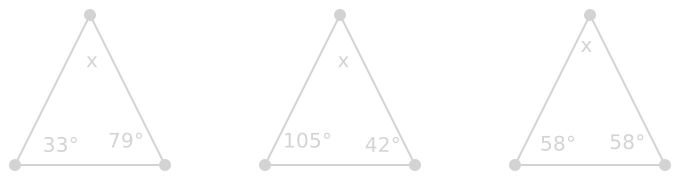
Exercise 3.
Find each exterior angle using supplementary angles:
a) interior angle
b) interior angle
c) interior angle

Exercise 4.
Find each adjacent angle using supplementary angles:
a) exterior angle
b) interior angle
c) interior angle
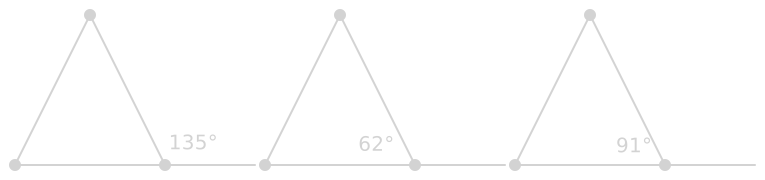
Exercise 5.
A triangle has an interior angle and an adjacent exterior angle. Find the other angle:
a) interior angle
b) exterior angle
c) interior angle
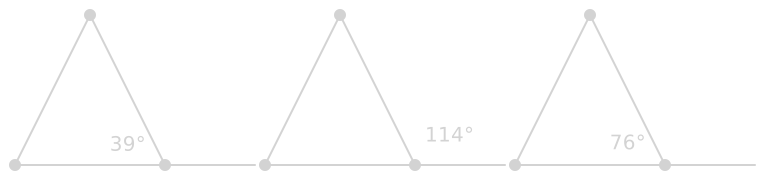
Exercise 6.
Decompose each polygon into triangles and find its interior angle sum:
a) quadrilateral
b) pentagon
c) hexagon

Exercise 7.
Decompose each polygon into triangles and find its interior angle sum:
a) heptagon
b) octagon
c) nonagon

Exercise 8.
Mixed practice:
a) Find the third angle of a triangle with angles
b) Find the interior angle next to an exterior angle of
c) Find the interior angle sum of a pentagon

Reasoning
Exercise 9.
Explain why the interior angles of a triangle always add to
Exercise 10.
A student says an exterior angle is any angle outside a polygon. Explain what is missing from this description.
Exercise 11.
Explain why an interior angle and its adjacent exterior angle in a triangle are supplementary.
Exercise 12.
A student says a pentagon can be decomposed into
Exercise 13.
Explain why the interior angle sum of a hexagon is greater than that of a quadrilateral.
Exercise 14.
A student finds an exterior angle by subtracting from
Problem-solving
Exercise 15.
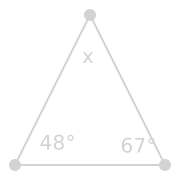
A triangular road sign has angles
Exercise 16.
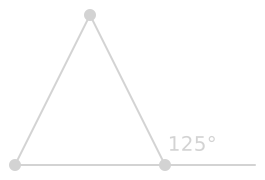
A triangle has an exterior angle of
Exercise 17.
A builder draws a pentagonal tile and wants to know the sum of its interior angles. Decompose it into triangles and find the sum.

Exercise 18.
A hexagonal window frame is split into triangles from one vertex. How many triangles are formed and what is the sum of the interior angles?

Exercise 19.
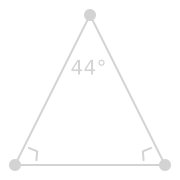
A triangle has interior angles
Exercise 20.
A quadrilateral and a pentagon are both decomposed into triangles. Compare their interior angle sums.

Potential Misunderstandings
- Students may think the interior angles of any polygon add to
rather than only a triangle - Students may confuse an exterior angle with a non-adjacent outside angle
- Students may forget that the exterior angle considered here forms a straight line with the interior angle
- Students may subtract from
instead of when finding an adjacent exterior angle - Students may count the number of triangles formed in a polygon incorrectly
- Students may think the number of triangles in a decomposed polygon is the same as the number of sides
- Students may forget that diagonals for decomposition are drawn from one vertex to non-adjacent vertices
- Students may find the number of triangles correctly but not multiply by
to get the interior angle sum