057. Angle Relationships and Angle Sums
Learning Intentions
- To know the meaning of the terms adjacent, complementary, supplementary, vertically opposite and perpendicular
- work with vertically opposite angles and perpendicular lines
- Solve angles at a point Use angle sums of
and
Pre-requisite Summary
- Understand that an angle is formed by two rays meeting at a vertex
- Be able to measure and Identify angles such as acute, right, obtuse and straight
- Know that a right angle is
and a straight angle is - Understand that angles can be named from diagrams with labelled points
- Be able to Identify when lines intersect
- Know that angles around a point make a full turn of
Worked Examples
Worked Example 1
a) Define the terms adjacent, complementary, supplementary, vertically opposite and perpendicular.
b) State whether two angles of
c) State whether two angles of
Worked Example 2
Two lines intersect and one angle is
a) State the size of the vertically opposite angle.
b) State the size of each adjacent angle.
c) Explain your reasoning.
Worked Example 3
A diagram shows two perpendicular lines. One angle is labelled
a) Write an equation using the angle sum of
b) Find
Worked Example 4
A straight line is split into two adjacent angles, one of which is
a) Write an equation using the angle sum of
b) Find the other angle.
Worked Example 5
Angles around a point are
a) Write an equation using the angle sum of
b) Find
Worked Example 6
Two intersecting lines create angles labelled
a) State the value of
b) Find
c) State which angles are vertically opposite and which are supplementary.
Problems
Problem 1
a) Define the terms adjacent, complementary, supplementary, vertically opposite and perpendicular.
b) State whether two angles of
c) State whether two angles of
Problem 2
Two lines intersect and one angle is
a) State the size of the vertically opposite angle.
b) State the size of each adjacent angle.
c) Explain your reasoning.

Problem 3
A diagram shows two perpendicular lines. One angle is labelled
a) Write an equation using the angle sum of
b) Find

Problem 4
A straight line is split into two adjacent angles, one of which is
a) Write an equation using the angle sum of
b) Find the other angle.

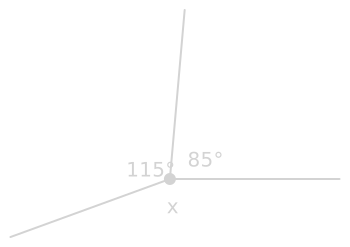
Problem 5
Angles around a point are
a) Write an equation using the angle sum of
b) Find
Problem 6
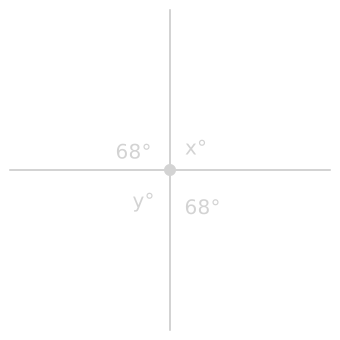
Two intersecting lines create angles labelled
a) State the value of
b) Find
c) State which angles are vertically opposite and which are supplementary.
Exercises
Understanding and Fluency
Exercise 1.
State the meaning of each term:
a) adjacent
b) complementary
c) supplementary
Exercise 2.
State the meaning of each term:
a) vertically opposite
b) perpendicular
c) adjacent angles
Exercise 3.
Decide whether each pair of angles is complementary, supplementary, or neither:
a)
b)
c)
Exercise 4.
Decide whether each pair of angles is complementary, supplementary, or neither:
a)
b)
c)
Exercise 5.
Two lines intersect. One angle is
a) the vertically opposite angle
b) one adjacent angle
c) the other adjacent angle
Exercise 6.
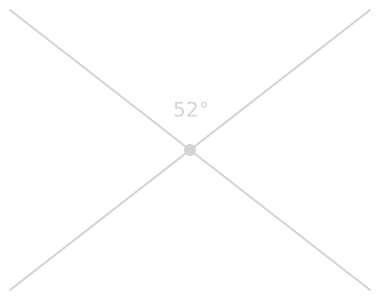
Two lines intersect. One angle is
a) the vertically opposite angle
b) one adjacent angle
c) the other adjacent angle

Exercise 7.
Find the missing angle on a right angle:
a)
b)
c)
Exercise 8.
Find the missing angle on a straight line:
a)
b)
c)
Exercise 9.
Find the missing angle around a point:
a)
b)
c)
Exercise 10.
Mixed practice:
a) If two lines are perpendicular, what is the size of each angle formed?
b) If one of two vertically opposite angles is
c) If two angles are supplementary and one is
Reasoning
Exercise 11.
Explain why vertically opposite angles are equal.
Exercise 12.
A student says that two adjacent angles must always be supplementary. Explain the mistake.
Exercise 13.
Explain why perpendicular lines create four right angles.
Exercise 14.
A student says that angles of
Exercise 15.
Explain why angles around a point add to
Exercise 16.
A student finds the angle next to
Problem-solving
Exercise 17.
At an intersection, one angle is

Exercise 18.
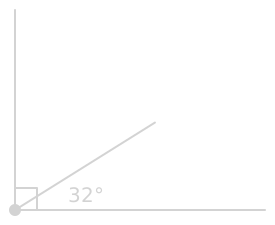
A carpenter checks two pieces of timber that meet at a right angle. One marked angle is
Exercise 19.
A road junction forms four angles. One angle is
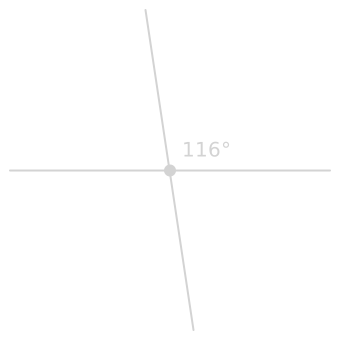
Exercise 20.
Three angles around a point are
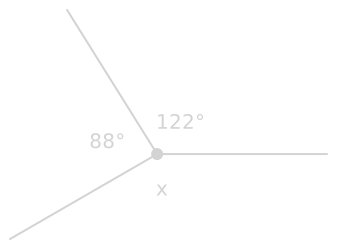
Exercise 21.
A straight line is split into three adjacent angles of

Exercise 22.
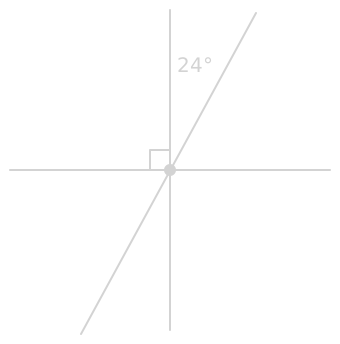
Two perpendicular lines are crossed by another line. One acute angle formed is
Potential Misunderstandings
- Students may confuse adjacent angles with vertically opposite angles
- Students may think complementary angles must be next to each other, when they only need to add to
- Students may think supplementary angles must be on a straight line, rather than understanding that they are any two angles summing to
- Students may forget that vertically opposite angles are equal
- Students may think perpendicular lines mean parallel lines
- Students may Use
instead of when working with perpendicular lines - Students may use the wrong angle sum, such as using
for angles on a straight line - Students may add angles when they should subtract from
, , or to find a missing angle