056. Geometry Terms and Measuring Angles
Learning Intentions
- To know the meaning of the terms point, vertex, intersection, line, ray, segment and plane
- To know the meaning of the terms acute, right, obtuse, straight, reflex and revolution
- To understand what collinear points and concurrent lines are
- name lines, segments, rays and angles in terms of labelled points in diagrams
- measure angles Use protractors
- Draw angles of a given size
Pre-requisite Summary
- Understand that diagrams Use labelled points, usually capital letters, to Describe positions
- Know that a point shows a location and has no size
- Recognise that a line extends in both directions, a ray extends in one direction, and a segment has two endpoints
- Understand that an angle is formed by two rays meeting at a common endpoint
- Know that degrees are used to measure angles
- Be able to Identify horizontal and vertical directions on a page
- Understand that the centre mark and baseline of a protractor must be aligned carefully
- Be able to read scales accurately from measuring tools
Worked Examples
Worked Example 1
a) Define the terms point, vertex, intersection, line, ray, segment and plane.
b) State which term describes the meeting point of two rays in an angle.
c) State which term describes the meeting point of two lines.
Worked Example 2
a) Define acute, right, obtuse, straight, reflex and revolution angles.
b) Identify angles of
c) State the size of a straight angle and a revolution.
Worked Example 3
a) Explain what collinear points are.
b) Explain what concurrent lines are.
c) Decide whether three named points on one straight line are collinear.
Worked Example 4
In a diagram with labelled points
a) Name the segment joining
b) Name the ray starting at
c) Name the angle with vertex at
Worked Example 5
a) Measure a labelled angle in a diagram using a protractor.
b) State whether the measured angle is acute, right, obtuse, straight or reflex.
c) Explain how to decide which protractor scale to read.
Worked Example 6
a) Draw an angle of
b) Draw an angle of
c) Explain the steps used to draw each angle accurately.
Problems
Problem 1
a) Define the terms point, vertex, intersection, line, ray, segment and plane.
b) State which term describes the meeting point of two rays in an angle.
c) State which term describes the meeting point of two lines.
Problem 2
a) Define acute, right, obtuse, straight, reflex and revolution angles.
b) Classify angles of
c) State the size of a straight angle and a revolution.
Problem 3
a) Explain what collinear points are.
b) Explain what concurrent lines are.
c) Decide whether three named points on one straight line are collinear.
Problem 4
In a diagram with labelled points
a) Name the segment joining
b) Name the ray starting at
c) Name the angle with vertex at
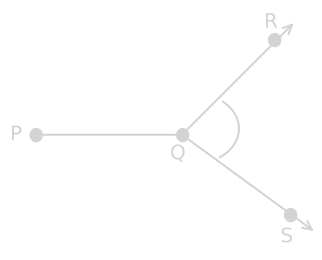
Problem 5
a) Measure a labelled angle in a diagram using a protractor.
b) State whether the measured angle is acute, right, obtuse, straight or reflex.
c) Explain how to decide which protractor scale to read.
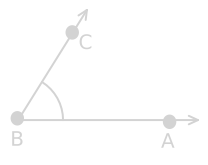
Problem 6
a) Draw an angle of
b) Draw an angle of
c) Explain the steps used to draw each angle accurately.
Exercises
Understanding and Fluency
Exercise 1.
State the meaning of each term:
a) point
b) line
c) segment
Exercise 2.
State the meaning of each term:
a) ray
b) vertex
c) plane
Exercise 3.
Classify each angle:
a)
b)
c)
Exercise 4.
Classify each angle:
a)
b)
c)
Exercise 5.
State whether the description matches a line, ray or segment:
a) has two endpoints
b) extends forever in one direction
c) extends forever in both directions
Exercise 6.
State whether the points or lines fit the term given:
a) three points on the same straight line — collinear or concurrent
b) three lines meeting at one point — collinear or concurrent
c) two lines crossing — intersection or vertex
Exercise 7.
In a labelled diagram with points
a) name the segment from
b) name the ray starting at
c) name the angle with vertex at
Exercise 8.
In a labelled diagram with points
a) name the angle with vertex at
b) state the vertex
c) state the two arms of the angle
Exercise 9.
Measure these drawn angles with a protractor:
a) one acute angle
b) one obtuse angle
c) one straight angle
Exercise 10.
Draw each angle using a protractor:
a)
b)
c)
Reasoning
Exercise 11.
Explain why a line and a segment are not the same object.
Exercise 12.
A student says that a ray has two endpoints. Explain the mistake.
Exercise 13.
Explain why
Exercise 14.
A student names an angle
Exercise 15.
Explain why three concurrent lines do not need to be collinear.
Exercise 16.
A student measures an angle from the wrong protractor scale and gets
Problem-solving
Exercise 17.
A diagram shows points
a) Which points are collinear?
b) Which lines are concurrent?
c) Name one angle with vertex
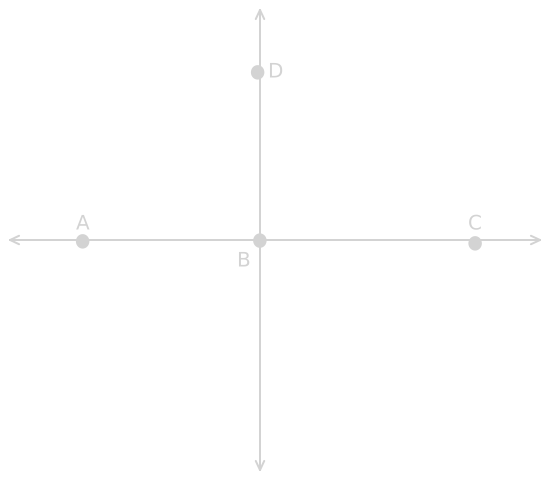
Exercise 18.
In a road map, three roads meet at a roundabout point
a) What geometry term describes the roads meeting at
b) If two road signs lie on the same straight road through
c) Name a real example of an intersection.
Exercise 19.
A carpenter needs a corner cut at
a) Classify each angle.
b) State which tool can be used to measure them.
c) Draw both angles.
Exercise 20.
A student draws rays
a) Classify the angle.
b) Name the angle correctly.
c) State the vertex.
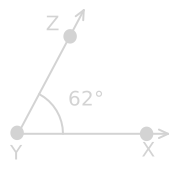
Exercise 21.
A clock hand model forms an angle of
a) Classify the angle.
b) Explain why it is not a straight angle.
c) Draw a similar reflex angle.
Exercise 22.
A surveyor marks three boundary points
a) State which points are collinear.
b) State which lines are concurrent.
c) Name a segment and a ray that could be formed from the labelled points.
Potential Misunderstandings
- Students may confuse a line, ray and segment because all are drawn similarly in diagrams
- Students may think a point has size or length
- Students may confuse an intersection with a vertex, even though one refers to crossing objects in general and the other to the corner point of an angle or shape
- Students may think collinear points and concurrent lines describe the same idea
- Students may confuse obtuse and reflex angles because both are greater than
- Students may forget that a straight angle is
and a revolution is - Students may name an angle with the vertex letter in the wrong position
- Students may read the wrong protractor scale when measuring an angle
- Students may place the centre of the protractor away from the vertex
- Students may align the protractor with the wrong arm when drawing a given angle