169r. Review Coordinates on the Number Plane
Learning Intentions
- Understand that coordinates can be used to Describe locations in two-dimensional space on a number plane
- Recognise the location of the four quadrants of a number plane
- Plot points at given coordinates
Pre-requisite Summary
- A number line shows the position of numbers Use equal intervals. See 049. Integers on the Number Line
- A horizontal direction and a vertical direction can be used together to describe position
- Ordered pairs are written in the form
. See 055. Cartesian Plane - The first coordinate gives horizontal movement and the second coordinate gives vertical movement
- Positive and negative numbers can both appear on a number plane
- The axes meet at the origin, which has coordinates
Worked Examples
Worked Example 1
State the coordinates of each point.
a) A point is
b) A point is
Worked Example 2
Name the quadrant for each point.
a)
b)
c)
Worked Example 3
Plot each point on a number plane.
a)
b)
c)
Worked Example 4
A point is plotted at
Explain why it is not in any quadrant.
Worked Example 5
A point is plotted at
Explain why it is not in any quadrant.
Worked Example 6
List the points that lie in Quadrant IV.
Problems
Problem 1
State the coordinates of each point.
a) A point is
b) A point is
Problem 2
Name the quadrant for each point.
a)
b)
c)
Problem 3
Plot each point on a number plane.
a)
b)
c)

Problem 4
A point is plotted at
Explain why it is not in any quadrant.
Problem 5
A point is plotted at
Explain why it is not in any quadrant.
Problem 6
List the points that lie in Quadrant II.
Exercises
Understanding and Fluency
Exercise 1.
Write the coordinates of each described point.
a)
b)
c)
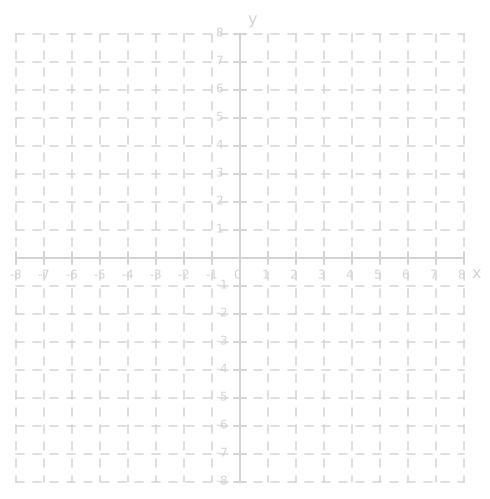
Exercise 2.
Write the coordinates of each described point.
a)
b)
c)
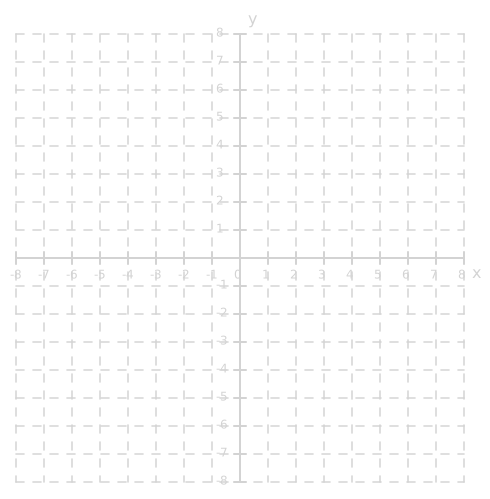
Exercise 3.
State the quadrant for each point.
a)
b)
c)
d)
Exercise 4.
State the quadrant for each point.
a)
b)
c)
d)
Exercise 5.
Plot each point on a number plane.
a)
b)
c)
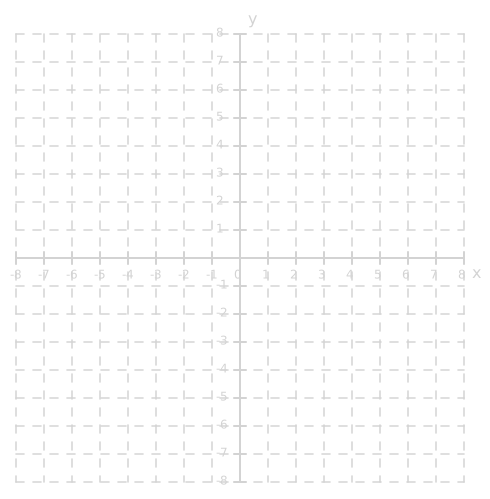
Exercise 6.
Plot the following points on a number plane.
a)
b)
c)
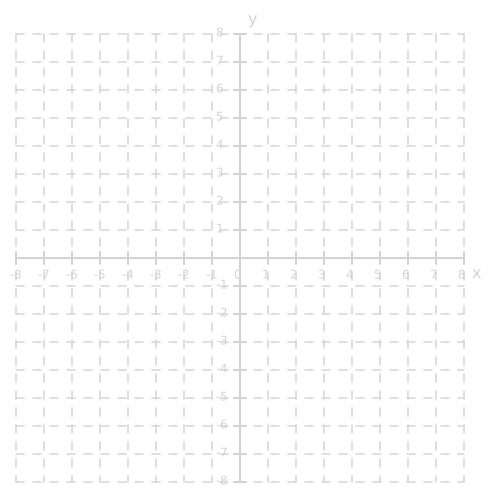
Exercise 7.
For each point, decide whether it lies in a quadrant or on an axis.
a)
b)
c)
d)
Exercise 8.
For each point, decide whether it lies in a quadrant or on an axis.
a)
b)
c)
d)
Exercise 9.
List the points in Quadrant I, Quadrant II, Quadrant III and Quadrant IV.
Exercise 10.
List the points in Quadrant I, Quadrant II, Quadrant III and Quadrant IV.
Reasoning
Exercise 11.
Explain why the point
Exercise 12.
A student says that the point
Exercise 13.
Explain why the order of the coordinates matters in an ordered pair such as
Exercise 14.
A student plots
Exercise 15.
Explain why points on the axes are not in any quadrant.
Problem-solving
Exercise 16.
A treasure map uses a number plane. The treasure is located
Exercise 17.
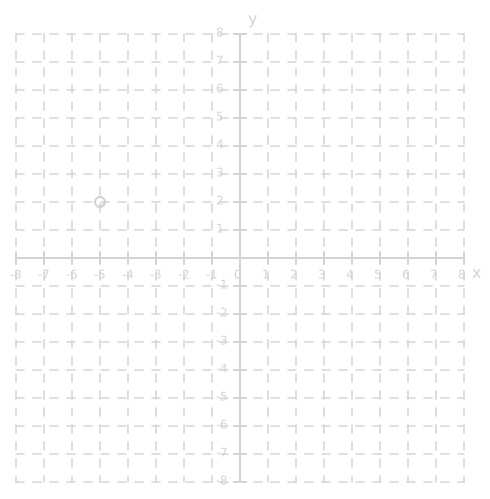
A robot moves to the point
Exercise 18.
Four towns are marked on a coordinate map at
State the quadrant of each town.
Exercise 19.
A point lies in Quadrant II and is
Exercise 20.
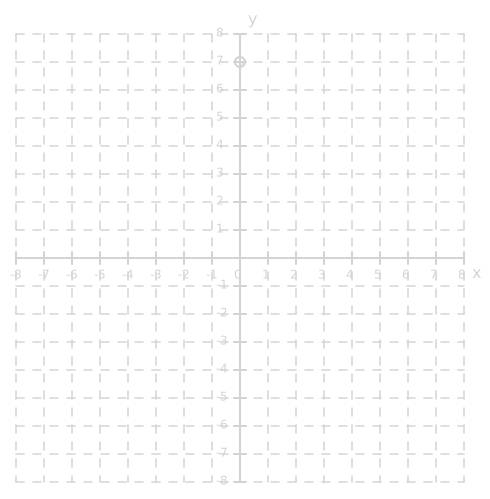
A point is plotted at
State whether it lies in a quadrant, and explain how you know.
Potential Misunderstandings
- Thinking the
-coordinate is read before the -coordinate - Forgetting that the first coordinate shows horizontal movement and the second shows vertical movement
- Confusing left with negative
and down with negative - Mixing up the positions of the four quadrants
- Thinking points on an axis belong to a quadrant
- Reversing the coordinates when plotting a point
- Treating
and as the same point - Forgetting that the origin is