164. Introduction to Probability
Learning Intentions
- Understand that a probability is a number between 0 and 1, representing the likelihood of an event
- Know the meaning of the terms experiment, trial, outcome, event, sample space and complement
- Calculate the probability of simple events
Pre-requisite Summary
- Fractions can be used to Describe part of a whole
- A number line can show values between
and - Some events are impossible, some are certain, and others lie in between
- A list of possible results can be made for a simple chance situation
- Division can be used to compare favourable outcomes with total outcomes
- Simple fractions can be interpreted as probabilities
Worked Examples
Worked Example 1
State whether each probability is impossible, unlikely, even chance, likely or certain.
a)
b)
c)
Worked Example 2
For rolling a fair six-sided die, Identify the experiment, one trial, the sample space and the event “rolling an even number”.
Worked Example 3
A fair coin is tossed once.
a) Write the sample space.
b) Solve the probability of getting heads.
c) Find the probability of not getting heads.
Worked Example 4
A fair six-sided die is rolled once.
a) Find the probability of rolling a
b) Find the probability of rolling a number greater than
Worked Example 5
A bag contains
a) Find the probability of choosing a red counter.
b) Find the probability of choosing a blue counter.
c) Find the probability of not choosing a red counter.
Worked Example 6
A spinner has
a) Find the probability of landing on yellow.
b) Find the probability of not landing on yellow.
Problems
Problem 1
State whether each probability is impossible, unlikely, even chance, likely or certain.
a)
b)
c)
Problem 2
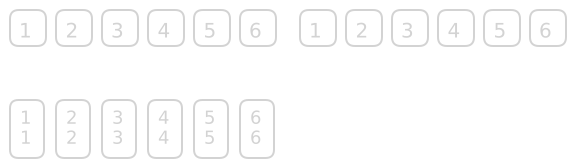
For choosing a card numbered
Problem 3
A fair coin is tossed once.
a) Write the sample space.
b) Find the probability of getting tails.
c) Find the probability of not getting tails.

Problem 4
A fair six-sided die is rolled once.
a) Find the probability of rolling a
b) Find the probability of rolling a number less than
Problem 5
A bag contains
a) Find the probability of choosing a green counter.
b) Find the probability of choosing a white counter.
c) Find the probability of not choosing a green counter.

Problem 6
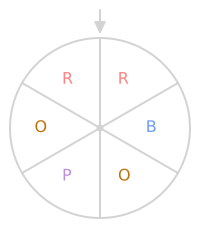
A spinner has
a) Find the probability of landing on orange.
b) Find the probability of not landing on orange.
Exercises
Understanding and Fluency
Exercise 1.
State whether each probability is impossible, unlikely, even chance, likely or certain.
a)
b)
c)
d)
e)
Exercise 2.
Write the matching probability for each description.
a) impossible
b) certain
c) even chance
Exercise 3.
For each situation, name the experiment and one possible outcome.
a) tossing a coin
b) rolling a six-sided die
c) choosing a coloured counter from a bag

Exercise 4.
Write the sample space for each experiment.
a) tossing a fair coin once
b) rolling a fair six-sided die once
c) choosing a card numbered

Exercise 5.
Find the probability of each event.
a) rolling a
b) tossing heads on a fair coin
c) choosing the card numbered

Exercise 6.
Find the probability of each event.
a) rolling an even number on a fair six-sided die
b) rolling a number greater than
c) choosing an odd number from cards numbered
Exercise 7.
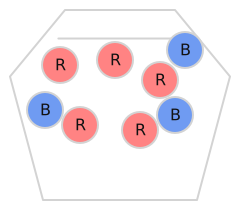
A bag contains
a) Find
b) Find
c) Find
Exercise 8.
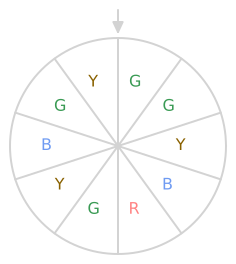
A spinner has
a) Find
b) Find
c) Find
Exercise 9.
For each event, find the complement probability.
a)
b)
c)

Exercise 10.
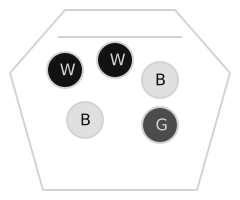
A bag contains
a) Find
b) Find
c) Find
d) Find
Reasoning
Exercise 11.
Explain why every probability must be between
Exercise 12.
A student says that the probability of an event can be
Exercise 13.
Explain the difference between an outcome and an event.
Exercise 14.
Explain why the complement of an event has probability
Exercise 15.
A student says the sample space for rolling a die is
Problem-solving
Exercise 16.
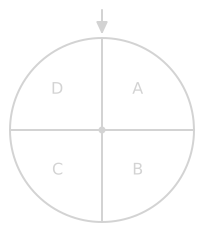
A game uses a fair spinner with equal sections labelled
a) Write the sample space.
b) Find the probability of landing on
c) Find the probability of not landing on
Exercise 17.
A box contains
a) Find the probability of choosing a blue pencil.
b) Find the probability of not choosing a blue pencil.
c) Which colour is most likely to be chosen?
Exercise 18.
A fair die is rolled once.
a) Find the probability of rolling a number less than
b) Find the probability of rolling a number not less than
c) Describe the second event as a complement.

Exercise 19.
A card is chosen at random from cards numbered
a) Find the probability of choosing a multiple of
b) Find the probability of not choosing a multiple of
c) State whether choosing a multiple of
Exercise 20.
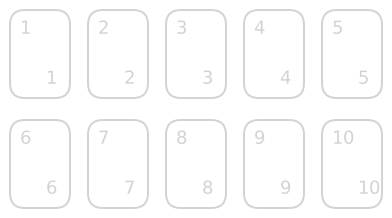
In a lucky dip, there are
a) Find the probability of getting a gold prize.
b) Find the probability of not getting a gold prize.
c) Explain whether getting a gold prize is likely or unlikely.

Potential Misunderstandings
- Thinking probability can be less than
or greater than - Confusing an event with a single outcome
- Thinking a trial means the same as the whole experiment
- Forgetting that the sample space includes all possible outcomes
- Believing the complement of an event is the same event
- Adding favourable outcomes incorrectly when finding probability
- Use the number of favourable outcomes as the denominator instead of the total number of outcomes
- Thinking all events on a die or spinner are equally likely even when the sections or contents are not equal
- Forgetting that impossible events have probability
and certain events have probability - Confusing “not” an event with only one other outcome instead of all remaining outcomes