159. Solving Inequalities Algebraically
Learning Intentions
- To understand that inequalities can be solved Use equivalent inequalities
- To understand that the sign of an inequality is reversed if both sides are multiplied or divided by a negative number
- To understand that the sign of an inequality is reversed if the two sides are switched
- Solve inequalities algebraically.
Pre-requisite Summary
- An inequality compares two values using symbols such as
, , and - A solution to an inequality is any value that makes the inequality true. 077. Solving Equations by Inspection
- An inequality can have many solutions, not just one
- Adding or subtracting the same term from both sides produces an equivalent inequality. See 151r. Reviewing Equivalent Equations and Solving Algebraically
- Multiplying or dividing both sides by a positive number keeps the inequality sign the same
- Multiplying or dividing both sides by a negative number reverses the inequality sign
- Switching the two sides of an inequality also reverses the sign, for example
is equivalent to - Solutions to inequalities can be shown on a number line using open or closed circles and arrows. See 158. Understanding and Representing Inequalities
Worked Examples
Worked Example 1
Solve
Worked Example 2
Solve
Worked Example 3
Solve
Worked Example 4
Solve
Worked Example 5
Solve
Worked Example 6
Solve
Worked Example 7
Solve
Worked Example 8
Solve
Problems
Problem 1
Solve
Problem 2
Solve
Problem 3
Solve
Problem 4
Solve
Problem 5
Solve
Problem 6
Solve
Problem 7
Solve
Problem 8
Solve
Exercises
Understanding and Fluency
Exercise 1.
Solve each inequality.
a)
b)
c)
Exercise 2.
Solve each inequality.
a)
b)
c)
Exercise 3.
Solve each inequality.
a)
b)
c)
Exercise 4.
Solve each inequality.
a)
b)
c)
Exercise 5.
Solve each inequality.
a)
b)
c)
Exercise 6.
Solve each inequality.
a)
b)
c)
Exercise 7.
Solve each inequality and represent the solution on a number line.
a)
b)
c)
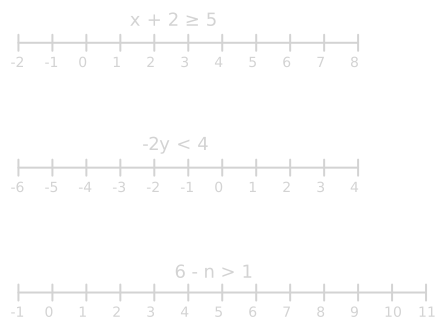
Exercise 8.
Solve each inequality and represent the solution on a number line.
a)
b)
c)
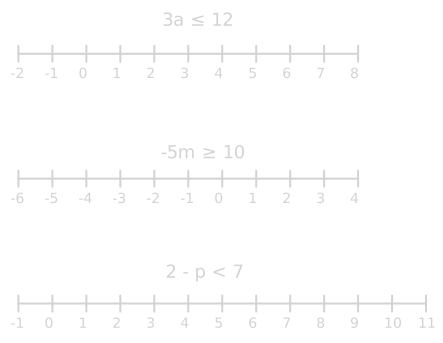
Reasoning
Exercise 9.
Explain why adding the same number to both sides of an inequality produces an equivalent inequality.
Exercise 10.
Explain why the inequality sign must reverse when both sides of
Exercise 11.
A student solves
Exercise 12.
Explain why
Problem-solving
Exercise 13.
A ride requires passengers to be taller than
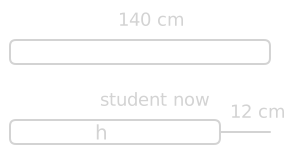
Exercise 14.
A phone plan allows a monthly spend of no more than $50. A customer has already spent $18 and each extra call costs $4. Let

Exercise 15.
A school rule says a bag must weigh less than

Exercise 16.
A taxi fare must be at least $25 to qualify for a discount. The fare is $5 flagfall plus $4 per kilometre. Let

Potential Misunderstandings
- Thinking inequalities are solved differently from equations in every step, rather than using similar ideas of equivalence
- Forgetting that adding or subtracting the same term from both sides keeps the inequality equivalent
- Reversing the inequality sign when multiplying or dividing by a positive number
- Forgetting to reverse the inequality sign when multiplying or dividing by a negative number
- Thinking the sign reverses whenever any number is moved across, rather than only in specific situations
- Confusing switching the two sides with keeping the same inequality sign
- Making sign errors when solving inequalities that involve subtraction
- Treating an inequality as if it has only one solution
- Using an open circle instead of a closed circle, or vice versa, when graphing the solution
- Forgetting to Check whether the final inequality makes sense in the original context