158. Understanding and Representing Inequalities
Learning Intentions
- To understand that an inequality is a mathematical statement that one value is larger than (or as large as) another value
- represent inequalities on a number line Use open or closed circles and/or arrows
- Describe real-life situations using inequalities
Pre-requisite Summary
- An equation states that two expressions are equal, but an inequality compares values that may not be equal
- The symbols
, , and compare numbers - A number line can be used to show the position of numbers relative to each other
- An open circle shows that an endpoint is not included in the solution set
- A closed circle shows that an endpoint is included in the solution set
- An arrow on a number line shows that the inequality continues indefinitely in one direction
- Real situations often involve limits, minimums and maximums, which can be described using inequalities
Worked Examples
Worked Example 1
State in words what each inequality means.
a)
b)
Worked Example 2
Represent each inequality on a number line.
a)
b)
Worked Example 3
Describe a real-life situation that could be represented by
Worked Example 4
Write an inequality for the statement: a ticket costs no more than $12.
Worked Example 5
Represent
Worked Example 6
Describe a real-life situation that could be represented by
Problems
Problem 1
State in words what each inequality means.
a)
b)
Problem 2
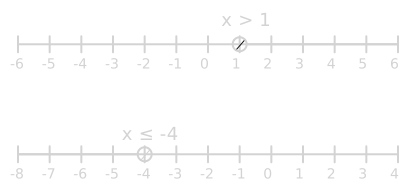
Represent each inequality on a number line.
a)
b)
Problem 3
Describe a real-life situation that could be represented by
Problem 4
Write an inequality for the statement: a bag must weigh at least
Problem 5
Represent

Problem 6
Describe a real-life situation that could be represented by
Exercises
Understanding and Fluency
Exercise 1.
Write each inequality in words.
a)
b)
c)
Exercise 2.
Write each inequality in words.
a)
b)
c)
Exercise 3.
For each inequality, state whether the endpoint is included.
a)
b)
c)
Exercise 4.
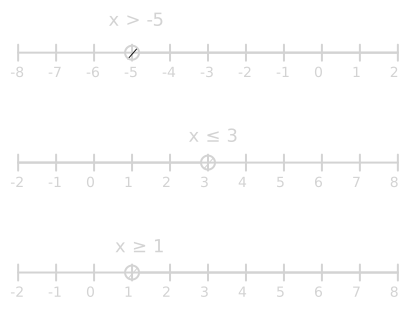
Represent each inequality on a number line.
a)
b)
c)
Exercise 5.
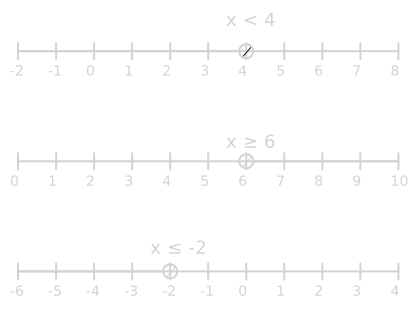
Represent each inequality on a number line.
a)
b)
c)
Exercise 6.
Match each inequality to the correct circle type (filled in or empty)
a)
b)
c)
Exercise 7.
Write an inequality for each description.
a) a number is greater than
b) a number is at most
c) a number is at least
Exercise 8.
Write an inequality for each description.
a) a temperature is below
b) a speed is no more than
c) a person is at least
Reasoning
Exercise 9.
Explain the difference between
Exercise 10.
A student uses a closed circle to represent
Exercise 11.
Explain why an arrow is needed when representing an inequality such as
Exercise 12.
Noah says that
Problem-solving
Exercise 13.
A ride at a theme park can be used only by people whose height
Exercise 14.
A cinema gives a child ticket to anyone younger than
Exercise 15.
A suitcase must weigh no more than
Exercise 16.
A school hall can hold at most
Exercise 17.
The outside temperature is forecast to stay above
Exercise 18.
A water tank must contain at least
Potential Misunderstandings
- Thinking an inequality is the same as an equation
- Confusing the meaning of
and - Forgetting that
and include equality - Using an open circle when the endpoint should be included
- Using a closed circle when the endpoint should not be included
- Drawing the arrow in the wrong direction on the number line
- Thinking an inequality has only one solution rather than many possible values
- Misreading phrases such as “at least”, “at most”, “no more than” and “less than”
- Writing an equation instead of an inequality for a real-life situation
- Forgetting to define what the variable represents in context