130. Pythagoras and Finding the Hypotenuse
Learning Intentions
- Use Pythagoras’ theorem to Solve the hypotenuse of a right-angled triangle
- To understand what a surd is
- Apply Pythagoras’ theorem to simple worded problems involving an unknown hypotenuse or diagonal
Pre-requisite Summary
- Know that a right-angled triangle has one angle of
- Be able to Identify the hypotenuse as the side opposite the right angle
- Recall that Pythagoras’ theorem is
for a right-angled triangle - Be able to square whole numbers and simple decimals
- Understand that the square root of a number is a value that, when multiplied by itself, gives the original number
- Know that not all square roots Simplify to whole numbers
- Be able to Interpret simple diagrams and worded geometry problems
Worked Examples
Worked Example 1
Find the hypotenuse of each right-angled triangle:
a) legs
b) legs
Worked Example 2
Find the hypotenuse of each right-angled triangle and give the exact answer first:
a) legs
b) legs
Worked Example 3
Write each answer as a surd, then as a decimal approximation where needed:
a) hypotenuse with legs
b) hypotenuse with legs
Worked Example 4
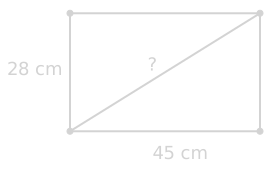
A rectangle has length
Worked Example 5
A ladder stands against a wall. The foot of the ladder is
Worked Example 6
A television screen is rectangular with side lengths
Problems
Problem 1
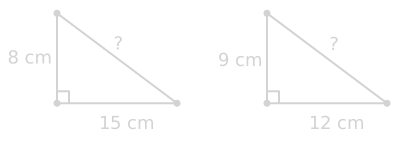
Find the hypotenuse of each right-angled triangle:
a) legs
b) legs
Problem 2
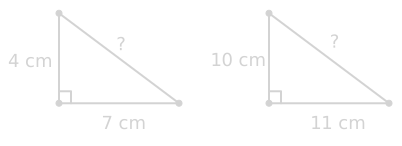
Find the hypotenuse of each right-angled triangle and give the exact answer first:
a) legs
b) legs
Problem 3
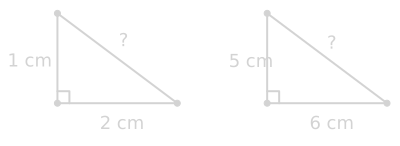
Write each answer as a surd, then as a decimal approximation where needed:
a) hypotenuse with legs
b) hypotenuse with legs
Problem 4
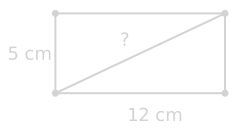
A rectangle has length
Problem 5
A ladder stands against a wall. The foot of the ladder is
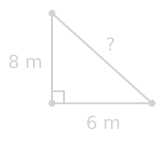
Problem 6
A rectangular tablet has side lengths
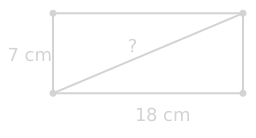
Exercises
Understanding and Fluency
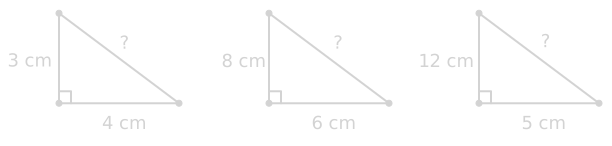
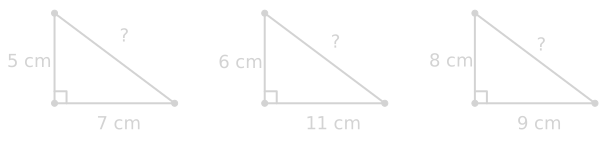
Exercise 1.
Find the hypotenuse of each right-angled triangle:
a) legs
b) legs
c) legs
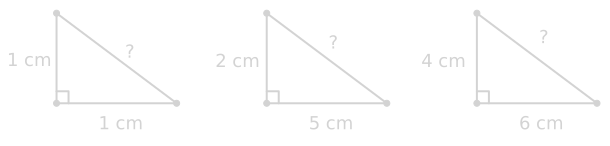
Exercise 2.
Find the hypotenuse of each right-angled triangle:
a) legs
b) legs
c) legs
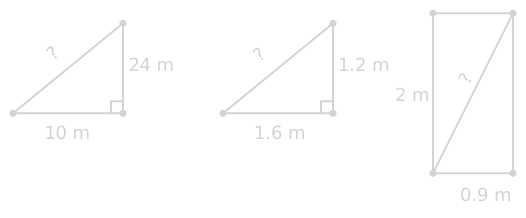
Exercise 3.
Find the hypotenuse and write the answer in simplest exact form:
a) legs
b) legs
c) legs
Exercise 4.
Find the hypotenuse and give a decimal approximation to
a) legs
b) legs
c) legs
Exercise 5.
State whether each number is a surd or not a surd:
a)
b)
c)
d)
Exercise 6.
Write each square root in simplest form if possible, and state whether it is a surd:
a)
b)
c)
d)
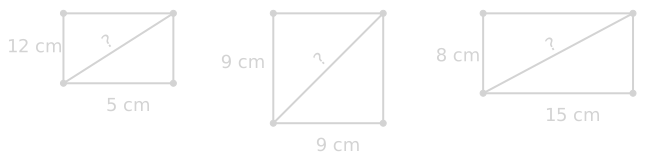
Exercise 7.
Find the diagonal of each rectangle:
a) length
b) length
c) length
Exercise 8.
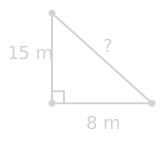
Solve each simple worded problem:
a) A kite string forms a right-angled triangle with horizontal distance
b) A ramp rises
c) A door is
Reasoning
Exercise 9.
Explain why the hypotenuse must be the side used as
Exercise 10.
A student says that
Exercise 11.
Noah says that the hypotenuse of a right-angled triangle with sides
Exercise 12.
Explain why a diagonal of a rectangle can be found Use Pythagoras’ theorem.
Exercise 13.
A student writes the hypotenuse of a triangle with legs
Problem-solving
Exercise 14.
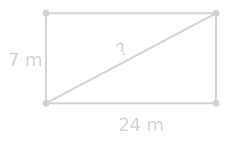
A rectangular garden is
Exercise 15.
A ladder reaches a window
Exercise 16.
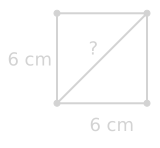
A square has side length
Exercise 17.
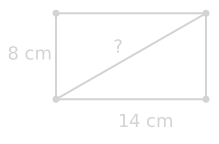
A phone screen is
Exercise 18.
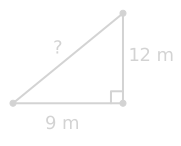
A sail forms a right-angled triangle with base
Exercise 19.
A rectangular painting is
Potential Misunderstandings
- Students may confuse the hypotenuse with one of the shorter sides
- Students may forget that the hypotenuse is opposite the right angle
- Students may Substitute the side lengths into Pythagoras’ theorem incorrectly
- Students may add the side lengths instead of adding their squares
- Students may forget to take the square root after finding
- Students may think any square root is a surd, even when it simplifies to a whole number
- Students may think a surd is just any decimal answer
- Students may give only a decimal approximation when an exact surd form is required
- Students may not Recognise that diagonals of rectangles create right-angled triangles
- Students may ignore units when answering worded problems