129. Right-Angled Triangles, Hypotenuse and Pythagorean Triples
Learning Intentions
- Identify the hypotenuse in a right-angled triangle
- Determine if three numbers form a Pythagorean triple
- Use Pythagoras’ theorem to determine if a triangle has a right angle based on its side lengths
Pre-requisite Summary
- Know that a right angle is
- Be able to identify a right-angled triangle from a diagram
- Know that the side opposite the right angle is special in a right-angled triangle
- Be able to square whole numbers
- Understand that a theorem is a mathematical rule that can be used to test a statement
- Be able to compare two numerical expressions to see if they are equal
Worked Examples
Worked Example 1
Identify the hypotenuse in each right-angled triangle:
a) a triangle with sides labelled
b) a triangle with side lengths
Worked Example 2
Determine whether each set of numbers is a Pythagorean triple:
a)
b)
c)
Worked Example 3
Determine whether each set of numbers is a Pythagorean triple:
a)
b)
c)
Worked Example 4
Use Pythagoras’ theorem to determine whether a triangle with side lengths
Worked Example 5
Use Pythagoras’ theorem to determine whether a triangle with side lengths
Worked Example 6
For each triangle, decide whether it is right-angled:
a) side lengths
b) side lengths
c) side lengths
Problems
Problem 1
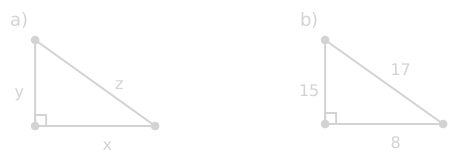
Identify the hypotenuse in each right-angled triangle:
a) a triangle with sides labelled
b) a triangle with side lengths
Problem 2
Determine whether each set of numbers is a Pythagorean triple:
a)
b)
c)
Problem 3
Determine whether each set of numbers is a Pythagorean triple:
a)
b)
c)
Problem 4
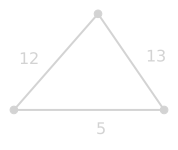
Use Pythagoras’ theorem to determine whether a triangle with side lengths
Problem 5
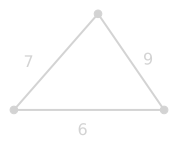
Use Pythagoras’ theorem to determine whether a triangle with side lengths
Problem 6
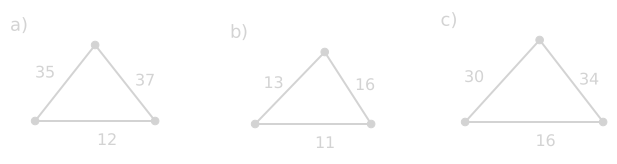
For each triangle, decide whether it is right-angled:
a) side lengths
b) side lengths
c) side lengths
Exercises
Understanding and Fluency
Exercise 1.
Complete each statement:
a) In a right-angled triangle, the hypotenuse is the side opposite the ______ angle
b) The hypotenuse is always the ______ side in a right-angled triangle
c) Pythagoras’ theorem is
Exercise 2.
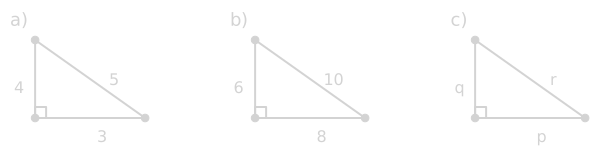
Identify the hypotenuse in each triangle:
a) sides
b) sides
c) sides labelled
Exercise 3.
Determine whether each set of numbers is a Pythagorean triple:
a)
b)
c)
d)
Exercise 4.
Determine whether each set of numbers is a Pythagorean triple:
a)
b)
c)
d)
Exercise 5.
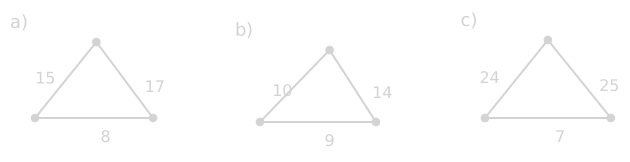
Use Pythagoras’ theorem to decide whether each triangle is right-angled:
a) side lengths
b) side lengths
c) side lengths
Exercise 6.
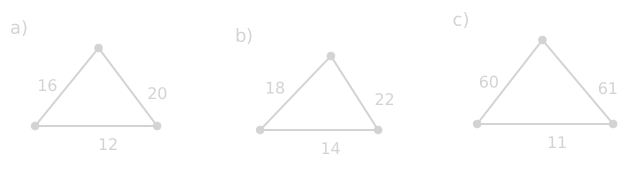
Use Pythagoras’ theorem to decide whether each triangle is right-angled:
a) side lengths
b) side lengths
c) side lengths
Exercise 7.
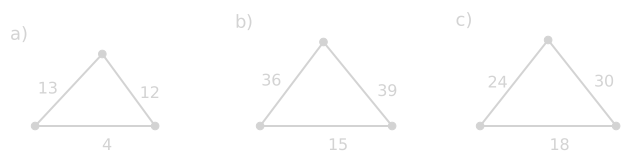
For each set of side lengths, identify the longest side first, then test for a right angle:
a)
b)
c)
Exercise 8.
Decide whether each statement is true or false:
a) Every set of three even numbers is a Pythagorean triple
b) In a right-angled triangle, the hypotenuse can be one of the shorter sides
c) If
d) The hypotenuse is opposite the right angle
Reasoning
Exercise 9.
Explain why the hypotenuse must always be the longest side in a right-angled triangle.
Exercise 10.
A student says that
Exercise 11.
Noah says that to test whether a triangle is right-angled, you can square any two sides and add them. Is he correct? Explain.
Exercise 12.
Explain why the longest side must be used as the value of
Exercise 13.
A student tests the numbers
Problem-solving
Exercise 14.
A triangular sign has side lengths
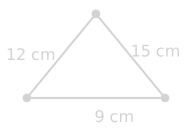
Exercise 15.
A ladder, the ground and a wall form a triangle with side lengths
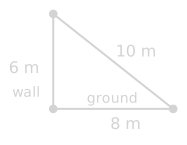
Exercise 16.
A builder measures a triangular frame with side lengths
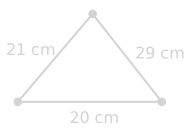
Exercise 17.
A right-angled triangle has side lengths
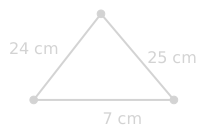
Exercise 18.
A student claims that a triangle with side lengths
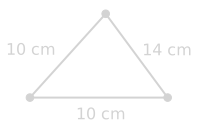
Exercise 19.
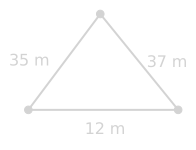
A surveyor measures three sides of a triangular plot as
Potential Misunderstandings
- Students may think the hypotenuse is any side that touches the right angle
- Students may forget that the hypotenuse is opposite the right angle, not beside it
- Students may not identify the longest side before testing Pythagoras’ theorem
- Students may use the wrong side as
in - Students may think only the triple
works and not Recognise multiples such as - Students may assume a triangle is right-angled just because the side lengths “look close”
- Students may make squaring errors when checking a Pythagorean triple
- Students may think that any three numbers with an even number among them form a Pythagorean triple
- Students may reverse Pythagoras’ theorem incorrectly when testing side lengths