084r. Metric Length and Reading Rulers
Learning Intentions
- Choose a suitable unit for a length within the metric system
- convert between metric lengths (km, m, cm and mm)
- read a length shown on a ruler or tape measure
Pre-requisite Summary
- Know that length measures how long, tall, or far something is
- Know that the metric system uses units based on powers of
- Know the relative sizes of
, , , and - Know that converting to a smaller unit gives a larger number
- Know that converting to a larger unit gives a smaller number
- Know that
- Know that
- Know that
- Know that ruler markings show equal intervals
- Know that a ruler can begin at
or that an object’s length can be found by subtracting two readings
Worked Examples
Worked Example 1
Choose the most suitable metric unit for each length.
a) The length of a pencil
b) The distance between two suburbs
c) The thickness of a coin
Worked Example 2
Convert the following lengths.
a)
b)
c)
Worked Example 3
Convert the following lengths.
a)
b)
c)
Worked Example 4
A ribbon is
Worked Example 5
Read the length of a line shown on a ruler marked in millimetres.
Worked Example 6
An eraser starts at the
Problems
Problem 1
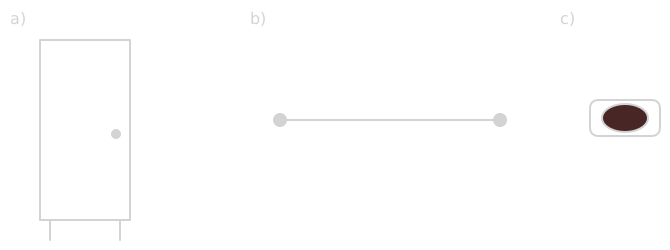
Choose the most suitable metric unit for each length.
a) The height of a classroom door
b) The distance from Brisbane to Sydney
c) The width of a fingernail
Problem 2
Convert the following lengths.
a)
b)
c)
Problem 3
Convert the following lengths.
a)
b)
c)
Problem 4
A rope is
Problem 5
Read the length of a line shown on a ruler marked in millimetres.

Problem 6
A crayon starts at the

Exercises
Understanding and Fluency
Exercise 1.
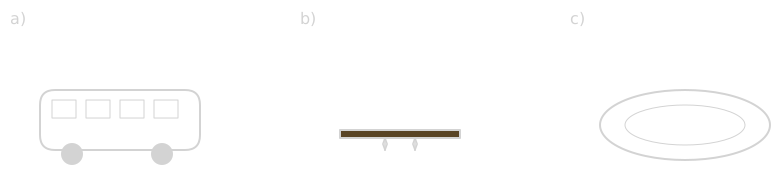
Choose the most suitable unit.
a) The length of a bus
b) The thickness of a sheet of cardboard
c) The distance around an athletics track
Exercise 2.
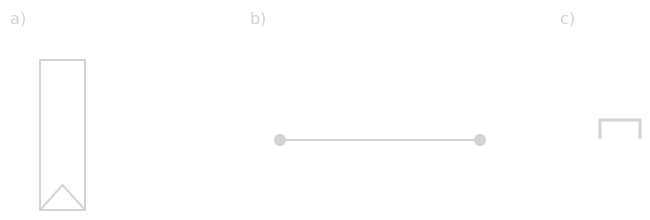
Choose the most suitable unit.
a) The length of a bookmark
b) The distance from one town to another
c) The width of a staple
Exercise 3.
Convert the following.
a)
b)
c)
Exercise 4.
Convert the following.
a)
b)
c)
Exercise 5.
Convert the following.
a)
b)
c)
Exercise 6.
Convert the following.
a)
b)
c)
Exercise 7.
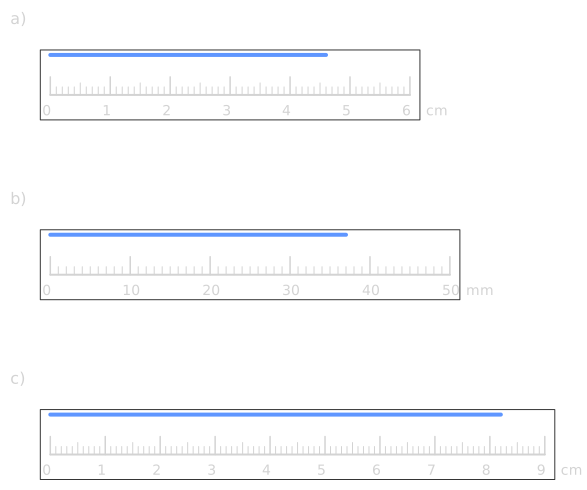
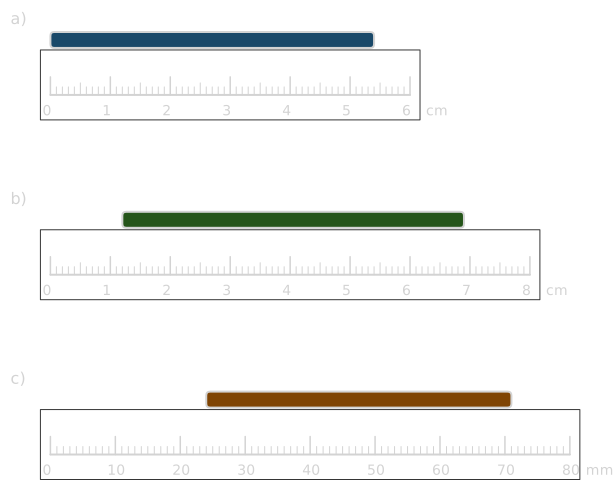
Read the indicated length on a ruler or tape measure.
a) A line ends at the
b) A line ends at the
c) A line ends at the
Exercise 8.
Find the length of each object from the ruler readings.
a) Starts at
b) Starts at
c) Starts at
Reasoning
Exercise 9.
Explain why centimetres are a better unit than metres for the length of a pen.
Exercise 10.
A student says
Exercise 11.
Explain why the length of an object measured from the
Exercise 12.
A student converts
Problem-solving
Exercise 13.
A hiking trail is
Exercise 14.
A ribbon is
Exercise 15.
A craft stick is
Exercise 16.
A builder measures a plank as
Exercise 17.
A toy car begins at the

Exercise 18.
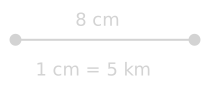
A map shows two towns are
Potential Misunderstandings
- A student may choose a unit that is much too large or much too small for the object being measured
- A student may confuse when to Use kilometres for long distances and when to use metres for shorter everyday lengths
- A student may think converting to a smaller unit means dividing, rather than multiplying
- A student may think converting to a larger unit means multiplying, rather than dividing
- A student may confuse the facts
and - A student may confuse the facts
and - A student may misread ruler markings by counting lines instead of intervals
- A student may read the final mark of an object on a ruler without subtracting the starting mark
- A student may assume every object starts at the
mark on a ruler - A student may write answers without appropriate units