060. Classifying and Constructing Triangles
Learning Intentions
- To understand that triangles can be classified by their side lengths (scalene, isosceles, equilateral) or by their interior angles (acute, right, obtuse)
- To know that in an isosceles triangle, the angles opposite the apex are equal and the two sides (legs) adjacent to the apex are of equal length
- Identify triangles based on side lengths or angles
- Draw triangles Use a protractor and ruler
Pre-requisite Summary
- Understand that a triangle has
sides, vertices and interior angles - Know that the interior angles of a triangle sum to
- Be able to Identify equal lengths and equal angles from markings in diagrams
- Know the meaning of acute, right and obtuse angles
- Know how to Use a ruler to measure length accurately
- Know how to use a protractor to measure and Draw angles
- Understand that side-length classification and angle classification Describe different properties of the same triangle
- Be able to name vertices and sides in a labelled diagram
Worked Examples
Worked Example 1
a) Define the triangle types scalene, isosceles and equilateral.
b) Define the triangle types acute, right and obtuse.
c) Explain how a triangle can be classified by both side lengths and angles.
Worked Example 2
For each triangle, classify it by side lengths:
a) side lengths
b) side lengths
c) side lengths
Worked Example 3
For each triangle, classify it by interior angles:
a)
b)
c)
Worked Example 4
An isosceles triangle has apex angle
a) State which sides are equal.
b) Explain which two angles are equal.
c) Solve the two equal base angles.
Worked Example 5
A labelled triangle
a) State the name of the triangle by side lengths.
b) Identify the apex vertex.
c) State the relationship between
Worked Example 6
Construct a triangle using ruler and protractor:
a) Draw base
b) At
c) At
Problems
Problem 1
a) Define the triangle types scalene, isosceles and equilateral.
b) Define the triangle types acute, right and obtuse.
c) Explain how a triangle can be classified by both side lengths and angles.
Problem 2
For each triangle, classify it by side lengths:
a) side lengths
b) side lengths
c) side lengths
Problem 3
For each triangle, classify it by interior angles:
a)
b)
c)
Problem 4
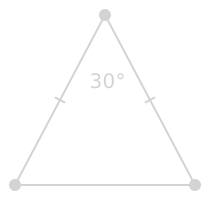
An isosceles triangle has apex angle
a) State which sides are equal.
b) Explain which two angles are equal.
c) Find the two equal base angles.
Problem 5
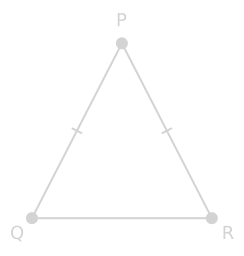
A labelled triangle
a) State the name of the triangle by side lengths.
b) Identify the apex vertex.
c) State the relationship between
Problem 6
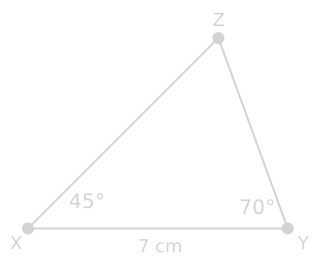
Construct a triangle using ruler and protractor:
a) Draw base
b) At
c) At
Exercises
Understanding and Fluency
Exercise 1.
Classify each triangle by side lengths:
a) sides
b) sides
c) sides
Exercise 2.
Classify each triangle by side lengths:
a) sides
b) sides
c) sides
Exercise 3.
Classify each triangle by angles:
a)
b)
c)
Exercise 4.
Classify each triangle by angles:
a)
b)
c)
Exercise 5.
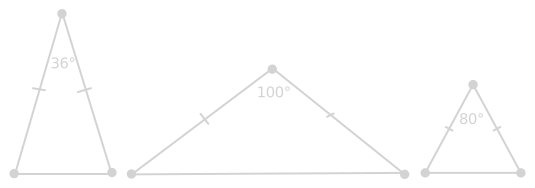
For each isosceles triangle, find the missing angles:
a) apex angle
b) apex angle
c) apex angle
Exercise 6.
For each isosceles triangle, find the apex angle:
a) base angles
b) base angles
c) base angles
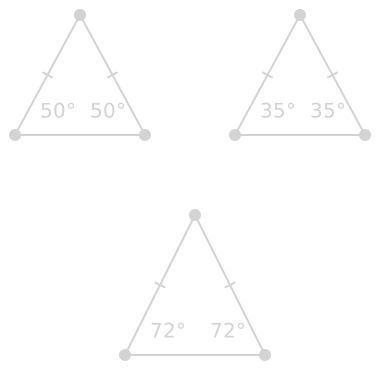
Exercise 7.
State all possible classifications for each triangle:
a) sides
b) sides
c) angles
Exercise 8.
Construct each triangle using ruler and protractor:
a) base
b) base
c) base
Reasoning
Exercise 9.
Explain why an equilateral triangle is also an isosceles triangle under the definition “at least two equal sides”.
Exercise 10.
A student says a triangle with angles
Exercise 11.
Explain why the base angles of an isosceles triangle must be equal.
Exercise 12.
A student says any triangle with two equal angles must be scalene. Explain why this is incorrect.
Exercise 13.
Explain why a triangle can be classified once by sides and once by angles.
Exercise 14.
A student constructs a triangle with base angles
Problem-solving
Exercise 15.
A triangle has two equal sides and one angle of
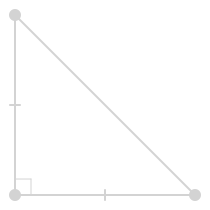
Exercise 16.
A builder marks a triangular support with side lengths
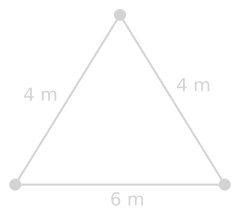
Exercise 17.
A triangular sign has interior angles
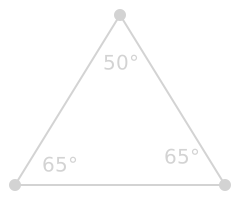
Exercise 18.
A triangle has one angle of
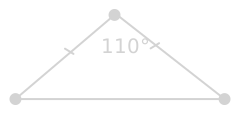
Exercise 19.
Construct a triangle with base
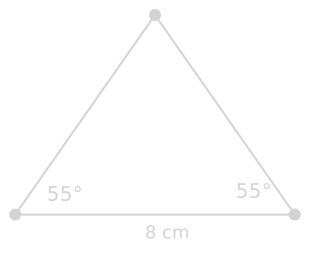
Exercise 20.
A roof truss is shaped like a triangle with equal sloping sides. The angle at the top is
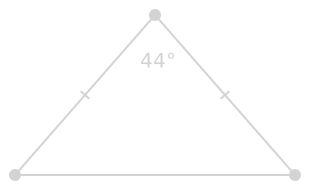
Potential Misunderstandings
- Students may confuse classification by side lengths with classification by angles
- Students may think a triangle can have only one classification in total
- Students may think an equilateral triangle is not isosceles because it has three equal sides rather than two
- Students may confuse the apex angle of an isosceles triangle with one of the equal base angles
- Students may forget that the equal angles in an isosceles triangle are opposite the equal sides
- Students may assume a triangle that looks equal-sided in a Draw must be equilateral without using given information
- Students may misread a protractor scale when constructing angles
- Students may place the protractor centre away from the vertex or align it with the wrong side
- Students may forget that the interior angles of a triangle must add to