128. Time Units, Time Formats and Time Zones
Learning Intentions
- convert between different units of time
- convert between times in 24-hour time and a.m./p.m.
- Use a time zone map to relate times in different locations in the world
Pre-requisite Summary
- Know that time is measured in units such as seconds, minutes and hours
- Know that
minute seconds and hour minutes - Know that there are
hours in a day - Be able to read analogue and digital times
- Understand the meaning of a.m. and p.m.
- Know that places around the world can have different local times
- Be able to add and subtract whole numbers when calculating time differences
- Understand that a time zone map shows offsets from a reference time
Worked Examples
Worked Example 1
Convert between units of time:
a)
b)
c)
Worked Example 2
Convert between units of time:
a)
b)
c)
Worked Example 3
Convert between 24-hour time and a.m./p.m.:
a)
b)
c)
Worked Example 4
Convert between 24-hour time and a.m./p.m.:
a)
b)
c)
Worked Example 5
Use a time zone map to relate times:
a) If it is
b) If it is
Worked Example 6
Use a time zone map to relate times:
a) If it is
b) If it is
Problems
Problem 1
Convert between units of time:
a)
b)
c)
Problem 2
Convert between units of time:
a)
b)
c)
Problem 3
Convert between 24-hour time and a.m./p.m.:
a)
b)
c)
Problem 4
Convert between 24-hour time and a.m./p.m.:
a)
b)
c)
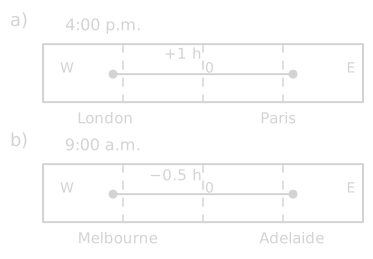
Problem 5
Use a time zone map to relate times:
a) If it is
b) If it is
Problem 6
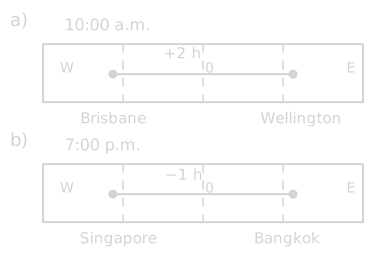
Use a time zone map to relate times:
a) If it is
b) If it is
Exercises
Understanding and Fluency
Exercise 1.
Complete each statement:
a)
b)
c)
d)
Exercise 2.
Convert between units of time:
a)
b)
c)
d)
Exercise 3.
Convert between units of time:
a)
b)
c)
d)
Exercise 4.
Convert each 24-hour time to a.m./p.m.:
a)
b)
c)
d)
Exercise 5.
Convert each a.m./p.m. time to 24-hour time:
a)
b)
c)
d)
Exercise 6.
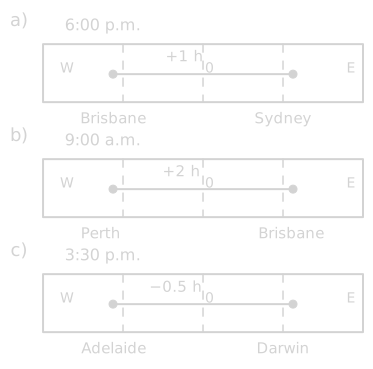
Use the given time zone difference to Solve the new time:
a) It is
b) It is
c) It is
Exercise 7.
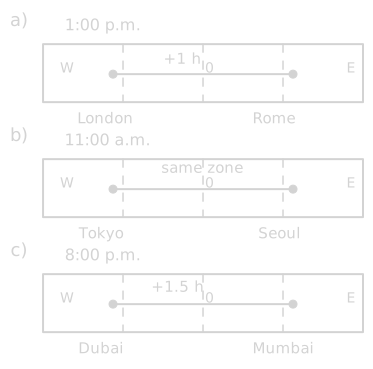
Use the given time zone difference to find the new time:
a) It is
b) It is
c) It is
Exercise 8.
Solve each:
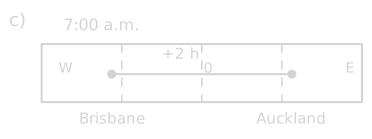
a) A movie lasts
b) A flight leaves at
c) If it is
Reasoning
Exercise 9.
Explain why
Exercise 10.
A student says that
Exercise 11.
Noah says that if one city is
Exercise 12.
Explain why a time zone map is useful when comparing times in different countries.
Exercise 13.
A student says that
Problem-solving
Exercise 14.
A train journey lasts
Exercise 15.
A concert starts at
Exercise 16.
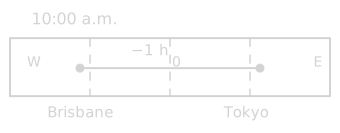
If it is
Exercise 17.
If it is

Exercise 18.
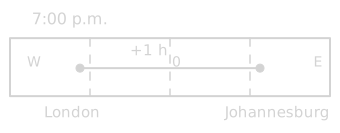
A live event is shown at
Exercise 19.
A lesson begins at
Potential Misunderstandings
- Students may confuse the conversion facts for seconds, minutes and hours
- Students may divide when they should multiply, or multiply when they should divide, when converting time units
- Students may think
minutes equals hour because of the base- number system - Students may confuse a.m. and p.m.
- Students may think
a.m. is noon instead of midnight - Students may think
p.m. is midnight instead of noon - Students may forget to add
when converting p.m. times to 24-hour time after midday - Students may incorrectly write
as p.m. - Students may add or subtract time zone differences in the wrong direction
- Students may ignore half-hour time differences on a time zone map
- Students may forget to adjust the day when a time crosses midnight