126. Volume and Capacity of Prisms
Learning Intentions
- To understand that volume is the space occupied by a three-dimensional object
- To understand that capacity is the volume of fluid or gas that a container can hold
- convert between units for volume and capacity
- Solve the volume of rectangular prisms, including cubes
Pre-requisite Summary
- Know that three-dimensional objects have length, width and height. See 092. Volume of Rectangular Prisms
- Understand that area measures the amount of surface inside a two-dimensional shape. See 125e. Nets and Surface Area of Prisms
- Know that volume measures space in three dimensions.
- Understand that volume is measured in cubic units such as
and - Understand that capacity is commonly measured in mL, L and kL
- Know basic metric conversions such as
. 094r. Capacity and Volume Conversions - Know that a cube is a special rectangular prism with all edges equal. 092. Volume of Rectangular Prisms
- Be able to multiply whole numbers and decimals accurately. 005. Multiplication Laws and Algorithms, and 044. Multiplying Decimals
Worked Examples
Worked Example 1
State the meaning of each term and Identify a suitable unit:
a) volume of a box
b) capacity of a water bottle
c) capacity of a swimming pool
Worked Example 2
Convert between units for volume and capacity:
a)
b)
c)
Worked Example 3
Convert between units for volume and capacity:
a)
b)
c)
Worked Example 4
Find the volume of each rectangular prism:
a) length
b) length
Worked Example 5
Find the volume of each cube:
a) side length
b) side length
Worked Example 6
A fish tank is a rectangular prism with length
a) Find its volume in
b) Convert this volume to litres
Problems
Problem 1
State the meaning of each term and identify a suitable unit:
a) volume of a cupboard
b) capacity of a milk carton
c) capacity of a dam
Problem 2
Convert between units for volume and capacity:
a)
b)
c)
Problem 3
Convert between units for volume and capacity:
a)
b)
c)
Problem 4
Find the volume of each rectangular prism:
a) length
b) length
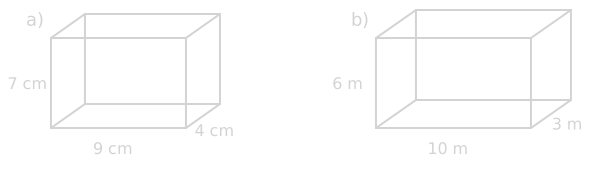
Problem 5
Find the volume of each cube:
a) side length
b) side length
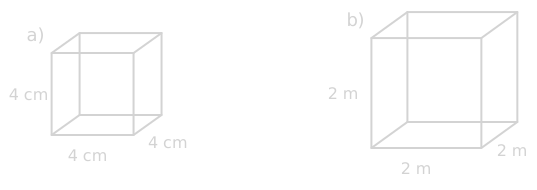
Problem 6
A storage container is a rectangular prism with length
a) Find its volume in
b) Convert this volume to litres
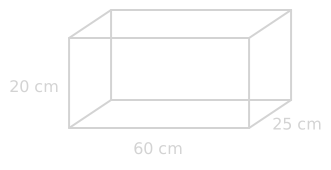
Exercises
Understanding and Fluency
Exercise 1.
Complete each statement:
a) Volume is the amount of ______ occupied by a 3D object
b) Capacity is the amount of fluid or gas a ______ can hold
c) Volume is measured in ______ units
d) Capacity is often measured in ______ and ______
Exercise 2.
State whether each measure is volume or capacity:
a) the amount of space inside a cardboard box
b) the amount of juice a bottle can hold
c) the amount of space occupied by a brick
d) the amount of water a tank can hold
Exercise 3.
Convert between units for capacity:
a)
b)
c)
d)
Exercise 4.
Convert between units for volume and capacity:
a)
b)
c)
d)
Exercise 5.
Find the volume of each rectangular prism:
a)
b)
c)
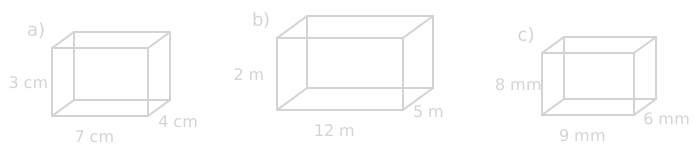
Exercise 6.
Find the volume of each cube:
a) side length
b) side length
c) side length
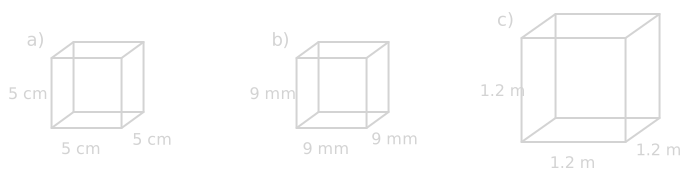
Exercise 7.
Find the volume, then convert where needed:
a) a prism
b) a cube with side
c) a prism
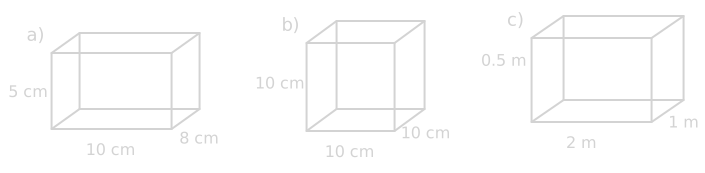
Exercise 8.
Solve each:
a) A rectangular prism has length
b) A cube has volume
c) A container has capacity
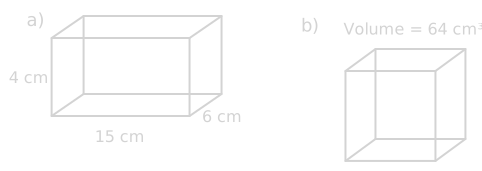
Reasoning
Exercise 9.
Explain why volume is measured in cubic units instead of square units.
Exercise 10.
A student says that the volume of a rectangular prism is found by adding length, width and height. Explain the mistake.
Exercise 11.
Noah says that
Exercise 12.
Explain why capacity and volume are closely related but not exactly the same idea.
Exercise 13.
A student says that a cube with side length
Problem-solving
Exercise 14.
A lunchbox measures
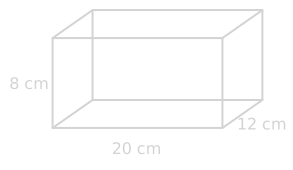
Exercise 15.
A carton has capacity
Exercise 16.
A fish tank measures
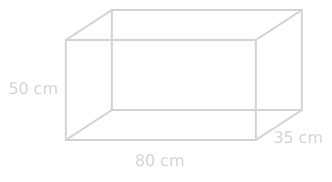
Exercise 17.
A cube-shaped container has side length
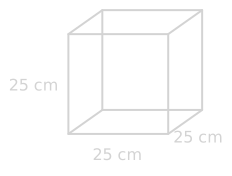
Exercise 18.
A swimming pool contains
Exercise 19.
A storage box has volume
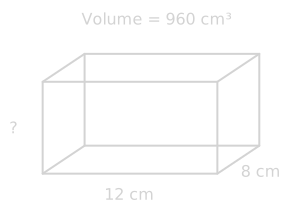
Potential Misunderstandings
- Students may confuse volume with area or perimeter
- Students may think capacity and volume mean exactly the same thing in every context
- Students may Use square units instead of cubic units for volume
- Students may forget that
- Students may forget that
- Students may forget that
- Students may add dimensions instead of multiplying them when finding volume
- Students may think the volume of a cube is found by doubling or squaring its side length instead of cubing it
- Students may confuse the units when converting between volume and capacity
- Students may not Check whether their final answer is reasonable for the size of the object