102r. Classifying and Relating Angles
Learning Intentions
- To know the meaning of the terms complementary, supplementary, vertically opposite and perpendicular
- Identify angles as acute, right, obtuse, straight, reflex or a revolution
- relate compass bearings to angles
- Determine the angles at a point Use angle properties
Pre-requisite Summary
- Know that an angle measures the amount of turn between two lines or rays
- Understand that angles are measured in degrees, written as
- Recall benchmark angles such as
, and - Be able to compare the size of two angles
- Know the four main compass directions: north, east, south and west
- Understand that a full turn is
and a half-turn is - Be able to Identify intersecting lines and points where lines meet
- Know that some angle relationships can be found without measuring
Worked Examples
Worked Example 1
State the meaning of each term:
a) complementary angles
b) supplementary angles
c) vertically opposite angles
d) perpendicular lines
Worked Example 2
Classify each angle:
a)
b)
c)
Worked Example 3
Classify each angle:
a)
b)
c)
Worked Example 4
Relate each compass turn to an angle:
a) a quarter-turn clockwise from north
b) a half-turn from east
c) a three-quarter turn clockwise from north
Worked Example 5
Solve the unknown angle at a point:
a) Angles around a point are
b) Angles around a point are
Worked Example 6
Use angle properties to find unknown angles:
a) Two complementary angles are
b) Two supplementary angles are
c) One of a pair of vertically opposite angles is
Problems
Problem 1
State the meaning of each term:
a) complementary angles
b) supplementary angles
c) vertically opposite angles
d) perpendicular lines
Problem 2
Classify each angle:
a)
b)
c)
Problem 3
Classify each angle:
a)
b)
c)
Problem 4
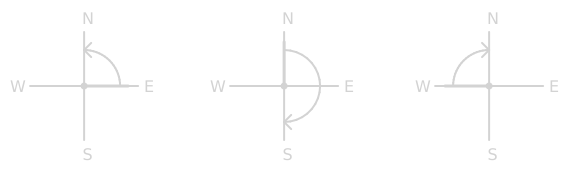
Relate each compass turn to an angle:
a) a quarter-turn anticlockwise from east
b) a half-turn from north
c) a three-quarter turn clockwise from west
Problem 5
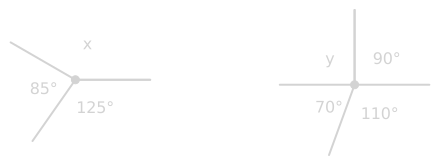
Find the unknown angle at a point:
a) Angles around a point are
b) Angles around a point are
Problem 6
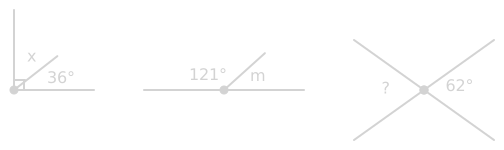
Use angle properties to find unknown angles:
a) Two complementary angles are
b) Two supplementary angles are
c) One of a pair of vertically opposite angles is
Exercises
Understanding and Fluency
Exercise 1.
Match each term to its meaning:
a) complementary
b) supplementary
c) vertically opposite
d) perpendicular
Exercise 2.
Classify each angle:
a)
b)
c)
d)
Exercise 3.
Classify each angle:
a)
b)
c)
d)
Exercise 4.
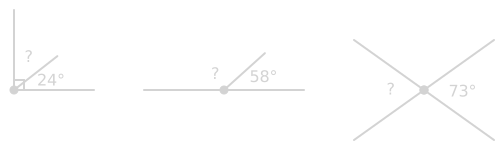
Find the missing angle:
a) An angle complementary to
b) An angle supplementary to
c) An angle vertically opposite to
Exercise 5.
Determine the angle of each turn:
a) a quarter-turn
b) a half-turn
c) a full turn
d) a three-quarter turn

Exercise 6.
Relate compass directions to angles:
a) clockwise from north to east
b) clockwise from north to south
c) clockwise from north to west
d) clockwise from east to north
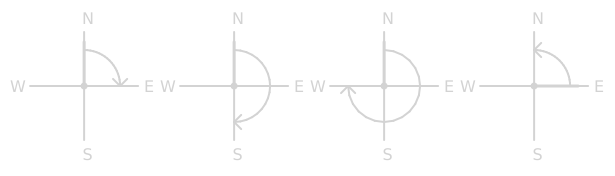
Exercise 7.
Find the unknown angle at a point:
a)
b)
c)
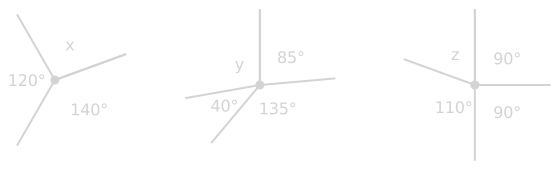
Exercise 8.
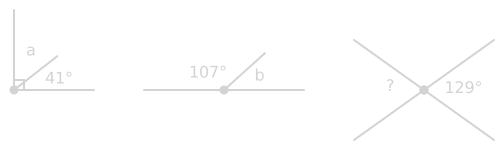
Use angle properties to find each unknown:
a)
b)
c) Vertically opposite to
Reasoning
Exercise 9.
Explain why two complementary angles cannot include an obtuse angle.
Exercise 10.
A student says that supplementary angles add to
Exercise 11.
Noah says that all angles bigger than
Exercise 12.
Explain why perpendicular lines always form right angles.
Exercise 13.
A student says that if one angle at a point is
Problem-solving
Exercise 14.
A compass needle turns clockwise from north to east, then from east to south. What total angle has it turned?
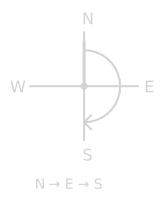
Exercise 15.
Two roads meet at right angles. Explain what this tells you about the roads.

Exercise 16.
At a point, three angles are
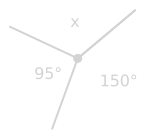
Exercise 17.
A ship changes direction by making a three-quarter clockwise turn from north. What direction is it now facing, and what angle has it turned through?
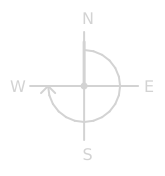
Exercise 18.
Two intersecting lines form one angle of
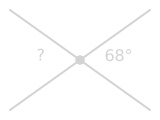
Exercise 19.
A mechanic turns a wheel through one full revolution and then a quarter-turn more. What total angle has the wheel turned through?
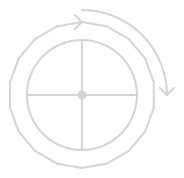
Potential Misunderstandings
- Students may think complementary angles add to
instead of - Students may think supplementary angles add to
instead of - Students may confuse vertically opposite angles with adjacent angles
- Students may think perpendicular lines can meet at any angle
- Students may confuse obtuse angles with reflex angles
- Students may think a straight angle is the same as a right angle
- Students may classify any large angle as a revolution, instead of recognising that a revolution is exactly
- Students may confuse clockwise and anticlockwise turns on a compass
- Students may forget that bearings and compass turns are measured from a starting direction
- Students may think angles at a point add to
instead of - Students may use the wrong angle property when finding unknown angles
- Students may assume vertically opposite angles are supplementary, rather than equal