094r. Capacity and Volume Conversions
Learning Intentions
- To understand that capacity is the volume of fluid or gas that an object can hold
- To know that common metric units include millilitres, litres, kilolitres and megalitres
- convert between common units for capacity
- convert between the volume and capacity of a container
Pre-requisite Summary
- Know that volume measures the amount of space inside a three-dimensional object
- Know that capacity measures how much fluid or gas a container can hold
- Know that capacity is commonly measured in
and - Know that
- Know that
- Know that
- Know that
- Know that
- Know that
- Know that converting to a smaller unit makes the number larger, and converting to a larger unit makes the number smaller
Worked Examples
Worked Example 1
State whether each measurement would usually Describe volume or capacity.
a) The amount of water a bottle can hold
b) The space inside a solid block
c) The amount of juice in a carton
Worked Example 2
Convert the following capacities.
a)
b)
c)
Worked Example 3
Convert the following capacities.
a)
b)
c)
Worked Example 4
A fish tank has volume
Worked Example 5
A water tank has volume
Worked Example 6
A container has capacity
Problems
Problem 1
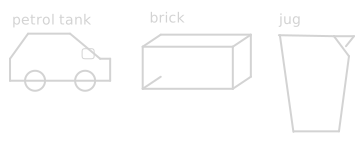
State whether each measurement would usually describe volume or capacity.
a) The amount of petrol a car tank can hold
b) The space inside a brick
c) The amount of milk in a jug
Problem 2
Convert the following capacities.
a)
b)
c)
Problem 3
Convert the following capacities.
a)
b)
c)
Problem 4
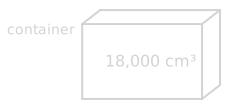
A container has volume
Problem 5
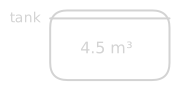
A tank has volume
Problem 6
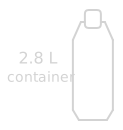
A container has capacity
Exercises
Understanding and Fluency
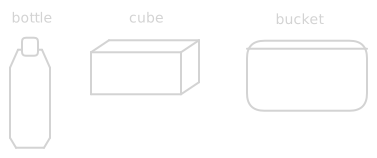
Exercise 1.
Decide whether each statement is about volume or capacity.
a) The amount of liquid a bottle can hold
b) The amount of space inside a cube
c) The amount of water in a bucket
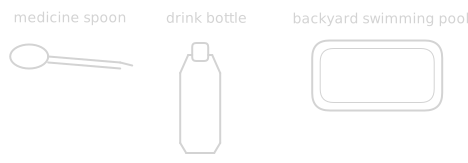
Exercise 2.
Choose the most suitable unit for each capacity.
a) A medicine spoon
b) A drink bottle
c) A backyard swimming pool
Exercise 3.
Complete the conversions.
a)
b)
c)
Exercise 4.
Convert the following.
a)
b)
c)
Exercise 5.
Convert the following.
a)
b)
c)
Exercise 6.
Convert the following.
a)
b)
c)
Exercise 7.
Convert between volume and capacity.
a)
b)
c)
Exercise 8.
Convert between volume and capacity.
a)
b)
c)
Reasoning
Exercise 9.
Explain why capacity is often used for containers, while volume is often used for solids.
Exercise 10.
A student says
Exercise 11.
Explain why
Exercise 12.
A student converts
Problem-solving
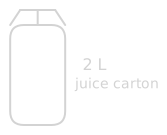
Exercise 13.
A juice carton holds
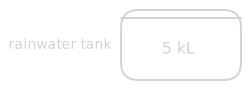
Exercise 14.
A rainwater tank has capacity
Exercise 15.
A reservoir holds
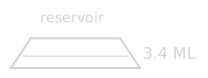
Exercise 16.
A rectangular fish tank has volume
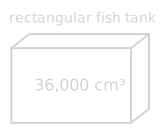
Exercise 17.
A water trough has volume
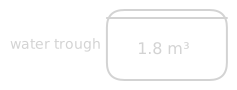
Exercise 18.
A bottle has capacity
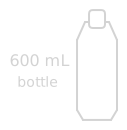
Potential Misunderstandings
- A student may confuse capacity with volume and think they always refer to exactly the same idea
- A student may not Recognise that capacity usually refers to how much fluid or gas a container can hold
- A student may think converting between capacity units uses addition or subtraction instead of multiplication or division by powers of
- A student may reverse the direction of conversion when moving between larger and smaller units
- A student may think
instead of - A student may not know that
- A student may confuse
with - A student may omit units or Use volume units when capacity units are expected, and vice versa