018. Spatial Patterns and Rules
Learning Intentions
- To know that a spatial pattern begins with a starting design and has a repeating design
- To understand how spatial patterns are related to number patterns
- continue a spatial pattern given the first few shapes
- Describe and Use a rule relating the number of shapes and the number of objects required to make them
Pre-requisite Summary
- Understand that a pattern follows a rule and repeats or grows in a predictable way
- Be able to Identify the first term or starting design in a pattern
- Be able to count objects accurately in a diagram or shape
- Understand that number patterns can increase or decrease by a constant amount
- Recognise that each new shape in a spatial pattern may add the same number of objects
- Be able to compare one design with the next to describe what changes
- Understand that a rule can connect the shape number to the number of objects used
- Be familiar with simple growing patterns made from matchsticks, tiles or dots
Worked Examples
Worked Example 1
A spatial pattern is made from squares in a row.
Shape
Shape
Shape
a) Describe the repeating change from one shape to the next.
b) State the related number pattern.
c) Draw or describe Shape

Worked Example 2
A pattern of triangles is growing.
Shape
Shape
Shape
a) Describe how the pattern grows.
b) State the number pattern.
c) Solve the number of counters in Shape

Worked Example 3
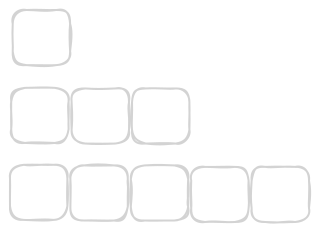
A pattern begins with one square tile. Each new shape adds
Shape
Shape
Shape
a) Continue the pattern for Shapes
b) State the number pattern.
c) Describe the rule in words.
Worked Example 4
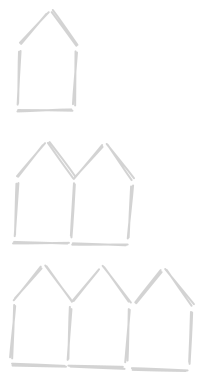
A row of joined pentagons is made with matchsticks.
Shape
Shape
Shape
a) Find the increase each time.
b) Write a rule relating shape number and number of matchsticks.
c) Find how many matchsticks are needed for Shape
Worked Example 5
A dot pattern has:
Shape
Shape
Shape
Shape
a) Describe the number pattern.
b) Explain how this relates to the spatial pattern.
c) Find the number of dots in Shape
Worked Example 6
A growing pattern of connected hexagons has:
Shape
Shape
Shape
a) State the number pattern.
b) Describe the growth of the spatial pattern.
c) Find a rule for the number of matchsticks in Shape
Problems
Problem 1
A spatial pattern is made from squares in a row.
Shape
Shape
Shape
a) Describe the repeating change.
b) State the related number pattern.
c) Draw or describe Shape
Problem 2
A pattern of triangles is growing.
Shape
Shape
Shape
a) Describe how the pattern grows.
b) State the number pattern.
c) Find the number of counters in Shape
Problem 3
A pattern begins with one square tile. Each new shape adds
Shape
Shape
Shape
a) Continue the pattern for Shapes
b) State the number pattern.
c) Describe the rule in words.
Problem 4
A row of joined pentagons is made with matchsticks.
Shape
Shape
Shape
a) Find the increase each time.
b) Write a rule relating shape number and number of matchsticks.
c) Find how many matchsticks are needed for Shape
Problem 5
A dot pattern has:
Shape
Shape
Shape
Shape
a) Describe the number pattern.
b) Explain how this relates to the spatial pattern.
c) Find the number of dots in Shape
Problem 6
A growing pattern of connected hexagons has:
Shape
Shape
Shape
a) State the number pattern.
b) Describe the growth of the spatial pattern.
c) Find the number of matchsticks in Shape
Exercises
Understanding and Fluency
Exercise 1.
A matchstick pattern has:
Shape
Shape
Shape
a) Write the next two terms in the number pattern.
b) State how many sticks are added each time.
Exercise 2.
A tile pattern has:
Shape
Shape
Shape
a) Write the next three terms.
b) Describe the rule in words.
Exercise 3.
A dot pattern has:
Shape
Shape
Shape
a) Find the common difference.
b) Find the number of dots in Shape
Exercise 4.
A pattern of joined squares uses matchsticks:
Shape
Shape
Shape
a) Find the number of matchsticks in Shape
b) Find the number of matchsticks in Shape
Exercise 5.
A pattern grows by adding
Shape
a) Write the first five terms.
b) Find the number of counters in Shape
Exercise 6.
A spatial pattern has the number pattern
a) State the common difference.
b) Find the
c) Find the
Exercise 7.
A pattern of triangles uses counters:
Shape
Shape
Shape
a) Find the number of counters in Shape
b) Find the number of counters in Shape
Exercise 8.
A row of connected pentagons uses matchsticks:
Shape
Shape
Shape
a) Find the increase each time.
b) Find the number of matchsticks in Shape
Exercise 9.
A dot pattern has:
Shape
Shape
Shape
a) Continue the pattern to Shape
b) Describe the rule.
Reasoning
Exercise 10.
Explain how the spatial pattern of joined squares is related to the number pattern
Exercise 11.
A student says the pattern
Exercise 12.
Why does a row of joined squares not increase by
Exercise 13.
A student says Shape
Problem-solving
Exercise 14.
A builder uses tiles to make a pattern. Shape
Exercise 15.
A matchstick pattern starts at
Exercise 16.
A pattern of dots has Shape
Exercise 17.
A pattern of connected hexagons uses
Exercise 18.
A student draws a growing pattern where each new shape adds
Potential Misunderstandings
- Students may think any picture pattern is repeating, when some spatial patterns are growing patterns
- Students may confuse the starting design with the repeating or growing part of the pattern
- Students may count all objects from scratch each time rather than noticing the constant increase
- Students may not connect the visual growth in the pattern to the related number pattern
- Students may describe the total number of objects instead of the change from one shape to the next
- Students may think a joined-shape pattern adds the full number of sides each time, ignoring shared sides
- Students may identify the wrong common difference in the number pattern
- Students may Apply an incorrect rule when finding a later term in the pattern
- Students may confuse the shape number with the number of objects in the shape